
Services
Protection against pigeons and swallows, installed by rope access
Bird barriers are nets, spikes and tensioned wires that physically stop birds from landing and nesting on a building. We install them by rope access or platform, so we reach ledges, parapets and balconies on any floor, and before installation we clean the surface of droppings and disinfect it.
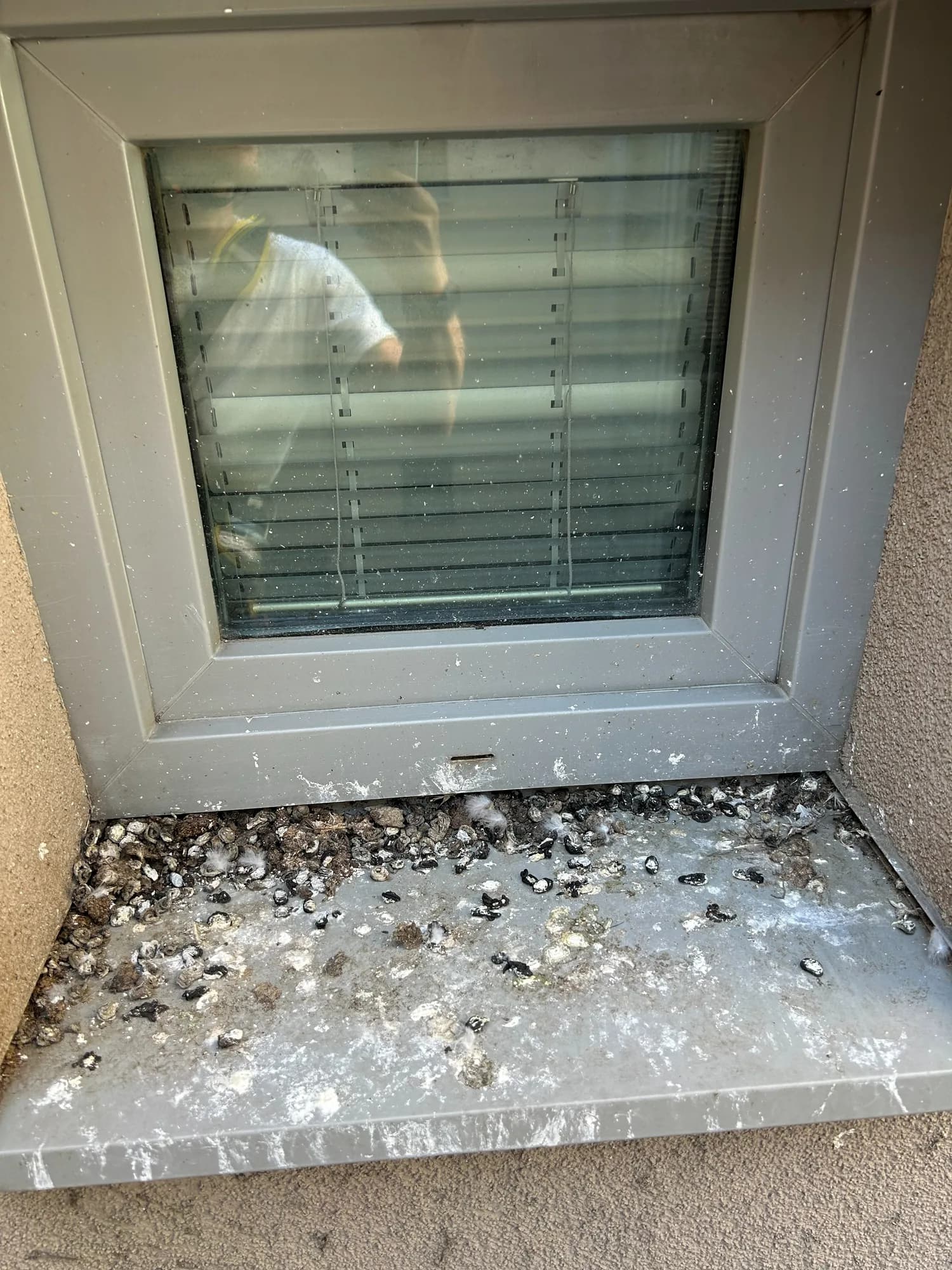
Pigeons do not settle on a building at random. They pick sheltered ledges, parapets, sills, light wells and unused loggias, that is places with shelter and a view. As long as such a spot stays accessible, neither stopping the feeding nor scaring the birds solves it, the pigeons return and rebuild the nest.
A working solution always has three steps: remove the droppings and disinfect the surface, block access with a physical barrier, and choose that barrier according to the bird species and the surface. That is why we install barriers only after cleaning, otherwise the mess would be sealed in under the net.
What's included
- Netting, spikes and tensioned wires matched to the bird species and surface
- Removal of pigeon droppings and disinfection before installation
- Rope-access installation, so no scaffolding and no pavement closure
- Stainless fixings that do not rust or stain the facade
- Solutions for balconies, loggias, ledges, parapets and light wells
- A process that respects the protection of protected bird species
Netting, spikes or wires? A comparison of bird barriers
There is no single barrier for everything. Netting closes off a whole space, spikes protect a narrow surface, wires suit places where the look must not change. The choice depends on whether you are dealing with pigeons or smaller birds, and on whether you want to close the space off or merely make landing impossible.
| Barrier | Where it fits | What to watch for |
|---|---|---|
| Pigeon netting | Balconies, loggias, light wells, plant floors and roof voids, that is anywhere a whole opening must be closed. | It must be tensioned and anchored along the whole perimeter. A sagging net is both an invitation and an entanglement risk. |
| Pigeon spikes | Ledges, sills, parapets and railing edges, that is narrow surfaces where birds perch. | A wide ledge needs several rows. A single row in the middle can be walked around and the spikes lose their point. |
| Tensioned wires | Historic and prestige facades where the barrier should stay practically invisible. | They work on larger birds. On small birds and in nesting spots they are weak. |
| Swallow and martin barriers | Soffits, the wall-to-ceiling junction and spots under the eaves where nests are stuck on. | They are installed strictly outside the nesting season while the nests are empty. See below. |
Pigeon netting: where it belongs and how we install it
Pigeon netting is the most reliable barrier wherever a whole opening needs closing rather than just an edge. We use UV-resistant polyethylene netting tensioned on a perimeter steel wire and anchored into the load-bearing structure, not into the thermal insulation.
We choose the mesh size according to the species. Pigeons call for a larger mesh, smaller birds for a denser one. An oversized mesh lets small birds inside where they get trapped, and that is exactly what we want to avoid.
- We match the net colour to the facade so it stands out as little as possible.
- Fixings are stainless, so no rust marks appear on the facade.
- Where access to the enclosed space is needed, we fit a zipped entry into the net.
Spikes against pigeons and against swallows
Pigeon spikes are not a tool for killing or injuring. They are blunt stainless wires on a base that stop a bird from folding its wings and settling. The bird approaches, finds no landing surface and moves on.
Density and the number of rows are decisive. A 15-centimetre ledge takes one row, a half-metre parapet needs three or four, otherwise the bird simply settles between them. We glue or screw the base depending on the surface, differently on sheet metal than on render.
DIY-store spikes usually fail not because they are bad, but because they are glued onto an uncleaned, greasy surface and drop off in the first frost. The surface must be degreased and dried first.
Pigeon netting for a balcony or loggia
A balcony or loggia is an ideal nesting site for pigeons, with a roof, shelter and quiet. The answer is netting tensioned around the perimeter of the opening, optionally combined with spikes on the railing. The net can be built so that the view and normal use of the balcony are preserved.
In an apartment block, work on an individual balcony is done from a rope from above, so we need neither to pass through neighbours' flats nor to erect scaffolding. Installing on one balcony takes hours rather than days.
Swallows and house martins: what is and is not allowed
The barn swallow and the house martin are protected animals in Slovakia under Act No. 543/2002 Coll. on nature and landscape protection. This means an occupied nest must not be damaged or removed without an exemption granted by the nature protection authority.
So on this type of job we offer two things: prevention, meaning barriers fitted outside the nesting season while nests are empty, and cleaning and disinfection of the surfaces beneath the nests. We do not remove occupied nests.
If you are unsure whether a nest is occupied or which rules apply to your building, contact the district office's environmental department. We are happy to wait for their position and plan the installation around it.
When to schedule it: the nesting season decides
Barriers make sense when they go up before the birds move in. The nesting season runs roughly from April to August, so the ideal time to install is from late summer to early spring. Anyone tackling it in May is usually dealing with an occupied nest rather than prevention.
With pigeons it is looser, as they nest almost year-round, but even there the best time is as soon as you notice the problem. The longer a spot is occupied, the more droppings there are to remove and the more the cleaning costs.
Pigeon droppings are not just an eyesore
Pigeon droppings are acidic and gradually attack the surfaces they sit on. On sheet metal and paint they cause corrosion, on render and stone they leave permanent stains, and in gutters and drains they form blockages that flood the roof in heavy rain.
The second dimension is hygiene. Dried droppings and nest material can carry agents of diseases transmissible to humans, such as ornithosis or histoplasmosis, as well as nest mites. That is why dry droppings should never be swept dry, as this raises dust.
Removing pigeon droppings and disinfecting
We clean and disinfect the surface before installation. We work wet so that no dust is released, collect and dispose of the contaminated material, and only then fit the barrier. Our operatives wear protective equipment including a respirator for this work.
- Damping the surface so dried droppings do not create dust.
- Mechanical removal of droppings and residual nest material.
- Washing the surface and applying disinfectant.
- Collecting and disposing of the waste, not dropping it from height.
- Fitting the barrier onto a clean, dry surface.
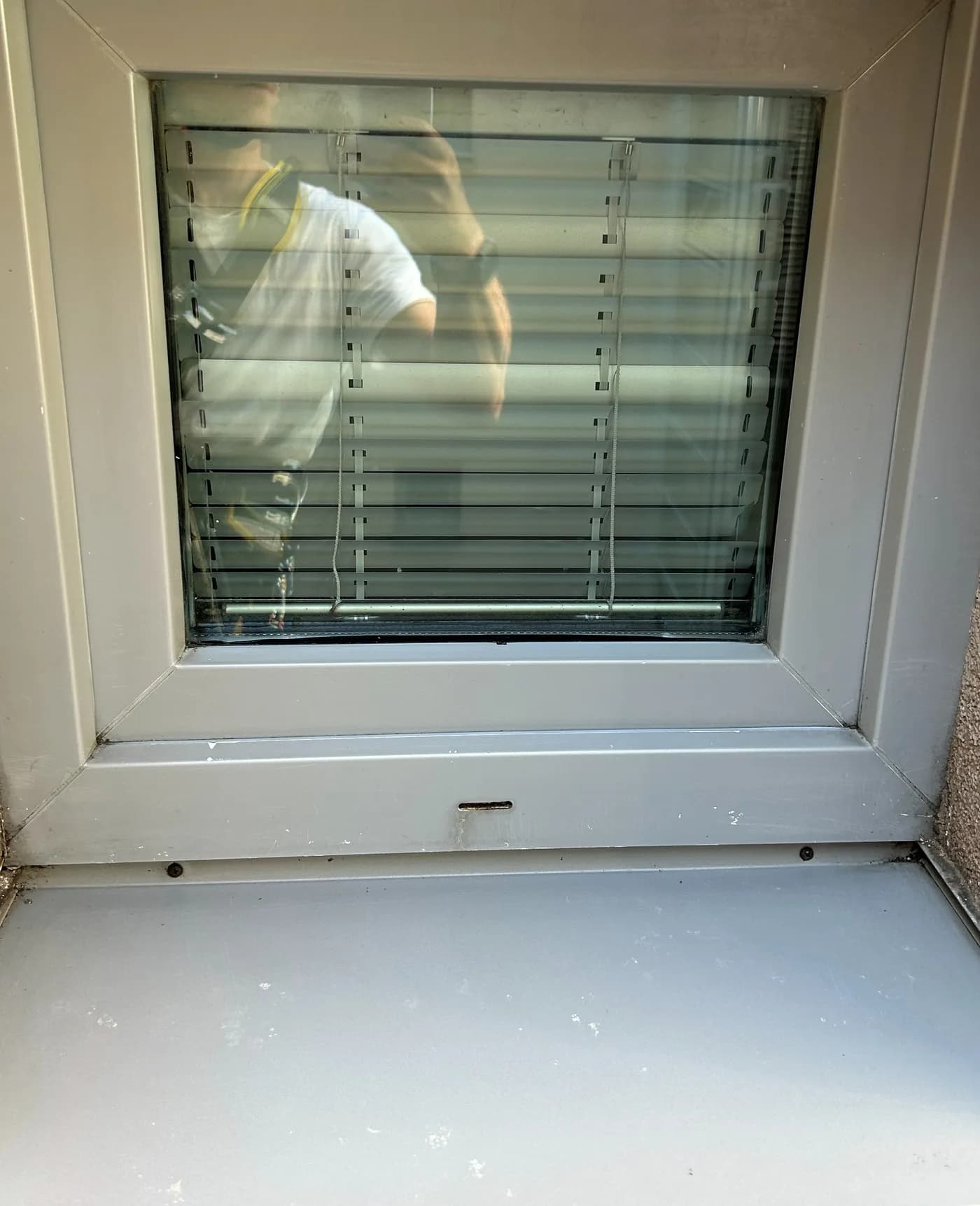
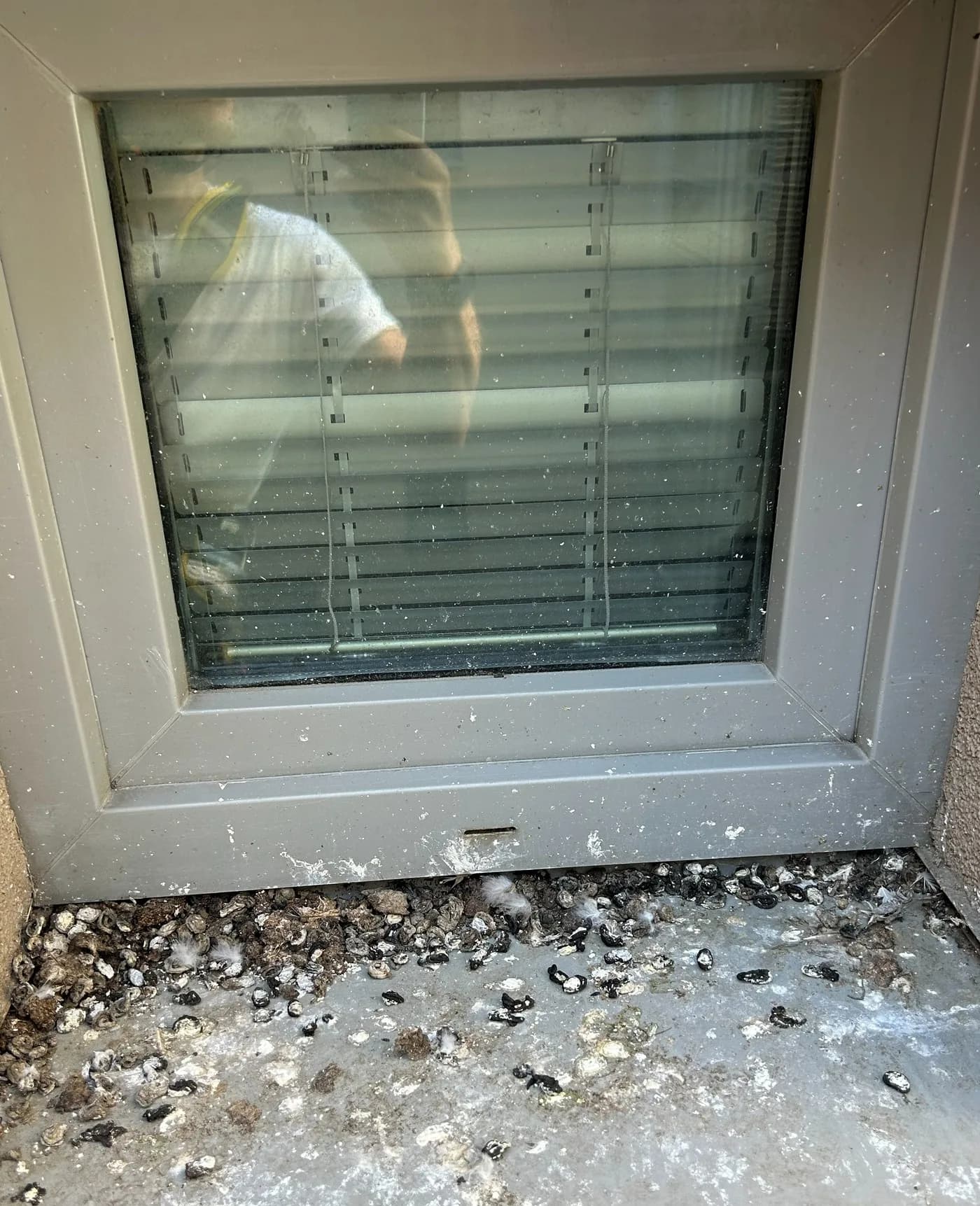
Drag the handle, or use the arrow keys.
Bird scarers: what works and what is wasted money
Plastic owls, mirror discs, reflective tape and ultrasonic scarers share one property: birds get used to them. The effect lasts days or weeks, then the pigeons work out that the owl does not move and perch straight on it. For that money it is better to fix the cause.
A physical barrier works differently. It does not frighten, it removes the place to land, and there is no getting used to that. That is why netting and spikes are the only solution that lasts years without further attention.
Where we install barriers
- Balconies and loggias on apartment blocks and family houses.
- Ledges, sills, parapets and railing edges.
- Light wells, glazed canopies and roof structures.
- Plant floors, machine rooms and roof voids.
- Industrial halls, warehouses and loading bays.
- Photovoltaic panels, under which pigeons like to nest.
- Advertising structures, illuminated signs and facade logos.
Pigeons under photovoltaic panels
The gap between panels and roof is ideal for pigeons: sheltered from above, warm and out of reach of predators. But a nest under a panel means droppings on the roof, blocked drainage and worse heat dissipation from the panels, which cuts their output.
The fix is a perimeter mesh clipped to the panel frame, so no drilling into the panel and no interference with the structure. We clean the space beneath the panels before fitting it.
Rope-access installation without scaffolding
Most places where pigeons nest are high up and awkward to reach. Rope access solves exactly that: we get to a ledge on the eighth floor with no scaffolding, no pavement closure and without having to pass through flats.
For an apartment block that also means a lower price. Scaffolding around the whole building never pays off when a few metres of netting are being fitted, whereas rope access handles the same job in a single working day.
Materials and how long they last
The life of a barrier is set by the material and the quality of the fixings, not by the price of the net itself. UV-resistant netting, properly tensioned, lasts years, while cheap netting without UV stabilisation goes brittle on a south facade within a season or two and starts to tear.
- Netting: UV-stabilised polyethylene, mesh sized to the species.
- Perimeter wire and anchors: stainless, so they do not rust or stain the facade.
- Spikes: stainless wires on a polycarbonate or stainless base.
- Adhesives: only where drilling is not allowed, and always on a degreased surface.
Will installation damage the facade or insulation?
On an insulated facade caution is warranted, because an anchor fixed only into the insulation will not hold a tensioned net and at the same time creates a thermal bridge and a path for water. So we anchor into the load-bearing structure behind the insulation and seal the penetrations.
Where drilling is not permitted, for example on a historic facade or on roof waterproofing, we use bonded or ballasted systems. There is always a way to do it without the barrier leaving damage behind.
DIY installation versus professional installation
Spikes and netting can be bought in a DIY store and on a ground-floor ledge or a sill at arm's height they are a sensible choice. The difference is not in the material but in three things: access at height, surface preparation, and whether the barrier covers the whole area.
The most common DIY mistake is an unfinished area. If even half a metre of gap is left, pigeons find it within a week and the whole investment is wasted. The second mistake is working from a ladder at a height where a ladder has no business being.
Apartment blocks: who approves it and how it is paid for
If the work concerns common parts of the building, that is the facade, ledges, parapet or roof, the owners decide through the manager or the association, and it is usually paid from the repair fund. For the manager we prepare the quote in a form that can be put to a meeting or a written vote.
For work on an individual balcony, most buildings require the manager's consent, because the change is visible on the facade. We recommend checking this in advance, it saves complications afterwards.
What drives the price
The price is set by the length of protected edge or the area of the opening, the height and access method, the type of barrier, and how much cleaning and disinfection is needed beforehand. The condition of the surface is usually the biggest difference between two similarly sized jobs.
- Running metres of ledge or square metres of opening to be closed.
- Height, and whether the work can be done from rope, from a platform or only from scaffolding.
- Type of barrier and fixing material, especially on an insulated facade.
- Extent of soiling by droppings and the need for disinfection.
- Access to the building and whether the area below the work must be secured.
How the survey works and what we need from you
In most cases photos are enough for a first estimate. Photograph the problem area both from a distance and close up, and tell us which floor it is on. If the job is larger or access is complicated, we come for a site survey and measure it up on the spot.
- A photo of the whole building showing the height and access.
- A close-up of the spot where the birds perch or nest.
- The approximate length of ledge or the size of the balcony opening.
- Whether the facade is insulated and whether it is a common part of the building.
Where in Bratislava we work
We work across Bratislava including Petržalka, Ružinov, Nové Mesto, Staré Mesto, Karlova Ves, Dúbravka, Rača, Vrakuňa and Podunajské Biskupice, and by arrangement also in Senec, Pezinok, Malacky and Stupava. Panel blocks in Petržalka and Ružinov make up the largest share of this type of work.
How it works
Survey and barrier design
From photos or on site we establish the species, exactly where they land and which surface needs protecting.
Cleaning and disinfection
We remove droppings and nest residue using a wet method and disinfect the surface.
Installation and gap check
We fit the barrier and walk the whole perimeter to check no gap is left for a bird to get through.
💡 The price depends on the length of protected edge or size of opening, the height, the type of barrier and the amount of cleaning. Send photos and dimensions and we usually quote within 24 hours.
Frequently asked questions
How much does pigeon netting on a balcony cost?
The price comes from the size of the opening, the floor height and how much cleaning is needed first. Send us a photo of the balcony and rough dimensions and we usually have a quote within 24 hours.
Will netting or spikes damage the facade?
Not when anchored correctly. On an insulated facade we anchor into the load-bearing structure behind the insulation and seal the penetrations; where drilling is not allowed we use bonded systems.
Do I need consent from the building manager or owners' association?
If it concerns common parts such as the facade, a ledge or the parapet, yes. For work on your own balcony most buildings also require it, because the change is visible from outside. We recommend checking before ordering.
How long does pigeon netting last?
UV-stabilised netting, properly tensioned and anchored with stainless fixings, lasts years. What shortens it is sagging, mechanical damage and cheap material without UV stabilisation.
What about the droppings already there?
We remove them and disinfect the surface before fitting the barrier. Netting over an uncleaned surface makes no sense, as the mess would be sealed underneath.
Do you work on the upper floors too?
Yes. That is exactly why we work from rope or a platform, so the floor level is no obstacle and we need neither scaffolding nor access through neighbours' flats.
Will you remove a swallow's nest?
Not an occupied one. Both the barn swallow and the house martin are protected species, and interfering with an occupied nest requires an exemption from the nature protection authority. We can, however, fit barriers outside the nesting season and clean the surfaces beneath the nests.
Do bird scarers such as plastic owls work?
Only briefly. Birds get used to a motionless object or a sound, usually within days or weeks. A physical barrier works permanently, because it does not frighten but removes the place to land.
Related services
Need cleaning or work at height?
Get in touch and we'll prepare a tailored, no-obligation quote, usually within 24 hours.