
Services
Emergency work at height within 24 hours
Emergency work at height means a fast response when something on a building is about to fall onto the pavement, a car or people, or when water is getting into flats after a storm. We treat such calls as a priority and usually attend within 24 hours; the first step is always to make the site safe, not to complete the final repair.
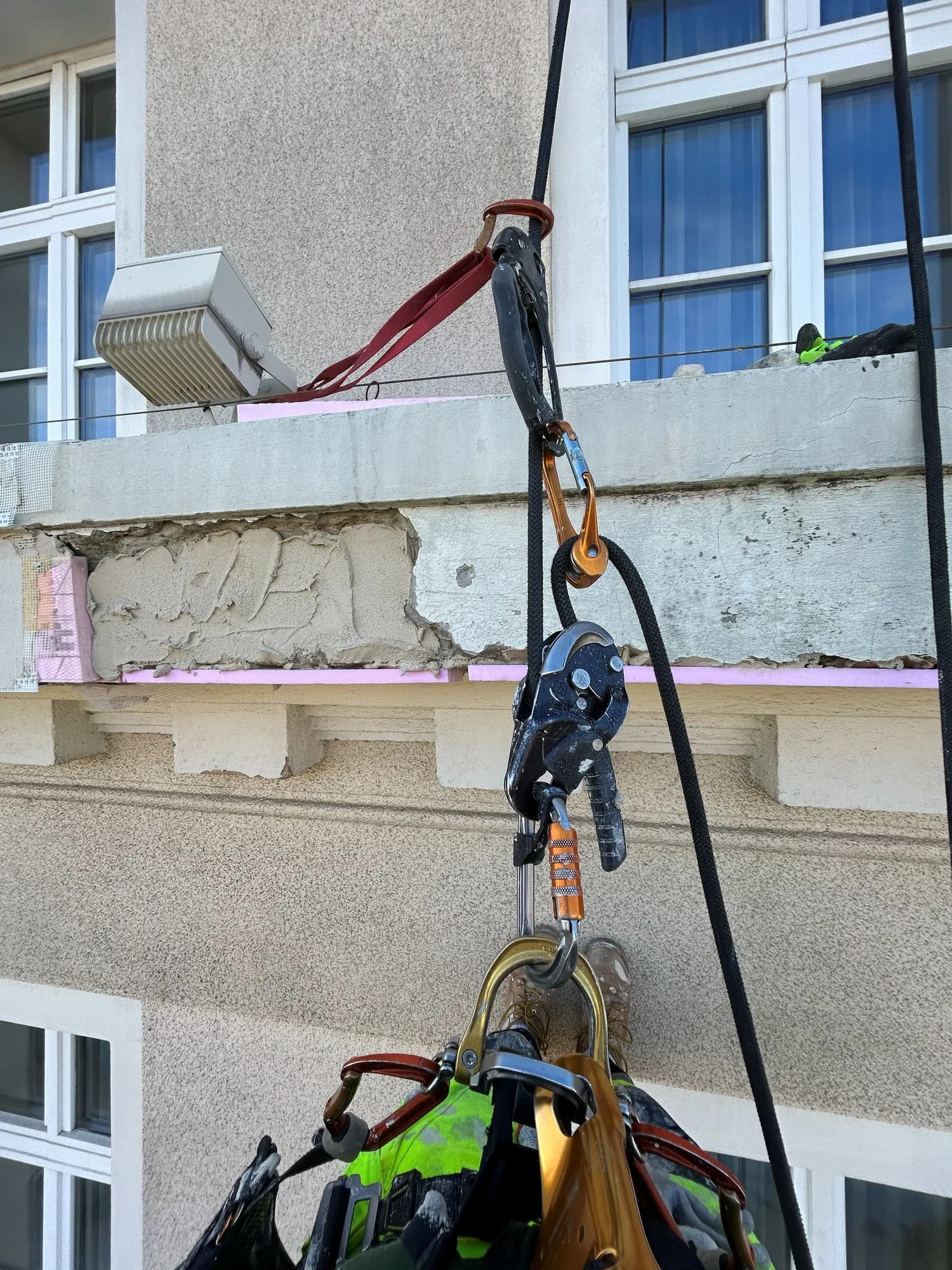
An emergency at height has one awkward property: it does not wait. A loose parapet flashing that is today holding on its last few screws will come down in the next gust, and it falls from a height where its weight stops mattering. So in this situation the question is not what will look better, but what removes the danger fastest.
We handle emergency calls out of turn and you can reach us by phone outside normal working hours too. Usually that means attending within 24 hours; after a windstorm or during widespread damage the wait can be longer, because many people call at once. In that case we tell you on the phone how to secure the area beneath the damage yourself until we arrive.
We work by rope access and from platforms, so we reach the damage without scaffolding. That is what matters in an emergency: erecting scaffolding around a building takes days and a pavement permit takes longer still, whereas on ropes we are at the parapet shortly after arriving on site.
What's included
- Emergency calls handled as a priority, usually attended within 24 hours
- The first step is making the site safe so nothing else can fall
- Access by rope or platform, so no waiting for scaffolding
- Photo documentation of the state before and after, for the insurer
- Temporary roof covering and sealing of the points where water gets in
- Public liability insurance covering damage caused during the work
What counts as an emergency at height and what can wait until Monday
An emergency is a situation where part of the structure could fall where people walk or cars are parked, or where water is actively damaging the interior. Everything else, meaning cosmetic defects, a water-stained ceiling or fallen render somewhere nobody walks, is an ordinary job and does not need a call-out at night.
This distinction matters for you too. An emergency call-out costs more than planned work, because it is done out of turn and often outside working hours. If there is genuinely no risk of anything falling, it pays to wait for a normal appointment and save money.
- It is urgent if there is a pavement, entrance, parking or playground beneath the damage.
- It is urgent if the damaged part visibly moves in the wind or something has already fallen from it.
- It is urgent if water is running into a flat, into a distribution board or along electrical wiring.
- It is not urgent if the damage is in a yard nobody uses and there is no water ingress.
The situation, the risk and how urgent it really is
This table is what we run through mentally when we pick up the phone. It will help you judge whether you are calling an emergency service or booking a slot for next week. If you are unsure, call anyway; an assessment over the phone costs you nothing.
| Situation | What is at risk | How urgent |
|---|---|---|
| Blown-off or loose parapet flashing | The sheet hangs over the pavement and will fall in the next gust, while water gets into the parapet and the wall. | Immediately; the area below must be cordoned off before we even arrive. |
| A hanging or shifted roof tile above an entrance | A fall onto a person or a car, plus water entering the loft and the insulation. | Immediately if it is above an entrance, otherwise usually within 24 hours. |
| Loose render or cladding above a pavement | It drops onto a passer-by, and the owner is liable for the harm caused. | Immediately where people pass below. Waiting to see if it holds does not help. |
| Cracked or fallen glass at height | Shards fall well away from the building and shatter into sharp pieces. | Immediately; cracked glass behaves unpredictably as the temperature changes. |
| A torn-off gutter or downpipe | Water runs down the facade and into the plinth; in winter it forms ice on the pavement below. | Within a few days. If the section is hanging and moving, then immediately. |
| A damaged advertising sign or illuminated board | The whole structure falls together with its fixings, and the supply cable is damaged. | Immediately, and the power supply must be disconnected at the same time. |
| A loose aerial, satellite dish or outdoor air-conditioning unit | The unit falls from height, punctures the roof covering and lets water in. | Immediately if it is above an entrance or balcony, otherwise within 24 hours. |
| Water entering a flat after a storm | Damaged ceilings, wet wiring and mould that shows up a few weeks later. | Fast, but the first step is a temporary cover, not repairing the roof covering. |
| A water-stained ceiling in a common area, with the leak already stopped | Deteriorating looks and render slowly loosening; nothing is at risk of falling. | It can wait for a normal appointment. An emergency call-out here is just wasted money. |
What to do before you call the emergency service
The first minute decides whether property damage turns into an injury. While we are on our way, the most important thing is that nobody stands and nothing parks beneath the damage. The rest can wait.
- Cordon off the area below the damage; tape, cones, a bench or chairs will do.
- Move people and cars away; expect sheet metal or a shard to land several metres from the wall.
- In an apartment block, put a notice on the entrance and the car park; neighbours cannot see it themselves.
- Do not climb up yourself, not on a ladder and not onto the roof, especially not in wind or rain.
- Photograph the damage from a distance and close up, send it to us and keep it for the insurer.
- If water is reaching wiring, switch off the affected circuit and have an electrician check it.
If something has already fallen and a person is injured beneath it, the first call is to 112, not to us. We deal with what is still hanging and what could come down next.
Why temporary securing comes first and the permanent repair second
In an emergency you cannot start with the repair. The damaged area has to be reached first, the extent established, and everything that is holding unreliably taken down. Only then can anyone say whether this is two metres of flashing or the whole parapet.
Temporary securing therefore means one of three things: we either take the loose part down and remove it, fix it back temporarily so it holds until the repair, or cover it with sheeting and a tarpaulin if water is getting in. The aim is not for it to look good, but for it to stop being dangerous.
The second reason is practical. A permanent repair needs material in the right size and colour, sometimes sheet metal made to measure, and that is not a matter of hours. Securing can be done straight away; the repair is scheduled for the next suitable date and weather window.
Blown-off parapet flashing and loose sheet metal on a facade
Parapet flashing is among the most common emergencies on panel and apartment blocks, and not by chance. The parapet is the highest point of the building, wind gets under the sheet from below and lifts it, and after years the fixings give way. One storm is enough for a two-metre section to hang over the edge.
Hanging sheet metal is dangerous also because it acts like a sail in the wind. It does not drop straight down, it flies away from the wall, and it has sharp edges. So during an emergency call-out we usually take the whole piece off, including the part that is still holding, because the adjoining section is normally just as loose.
Once flashing blows off, the top edge of the parapet is exposed and takes in water. Left until spring, the problem is no longer the sheet metal but a soaked parapet and damaged roof waterproofing.
A hanging tile and damaged roof covering
On a pitched roof an emergency is easy to spot: there is a visible gap or a shifted piece in a row of tiles. Wind gets under the covering wherever it was already disturbed, that is at the ridge, in the valleys and around the chimney, and from there it lifts the neighbouring pieces too.
In an emergency we handle two things at once. We take down or secure the pieces that could fall, and cover the opening temporarily so water does not reach the loft. Replacing the covering and checking the battens is a separate job, done in dry weather.
Loose render, cladding and pieces of cornice above a pavement
This is the type of emergency most often underestimated, because render does not hang conspicuously like sheet metal. Yet a palm-sized piece of render falling from the fourth floor can injure someone seriously. You recognise it by cracks, bulging and a hollow sound if the area can be tapped.
During the call-out we knock off everything that is not holding, including the area around the damage, until we reach a sound substrate. It sounds drastic, but it is the only honest approach. Leaving behind a piece that comes loose in two weeks means another call-out and more damage.
The follow-up repair, meaning local patching, re-rendering and blending the surface, is separate work. We do that too, but as planned work and at temperatures where the mortar can cure.
Cracked and fallen glass at height
Glass is peculiar in that there is nothing gradual between it holding and it being on the ground. A cracked pane in a glazed wall, a canopy or a loggia balustrade can hold for a week and then fall out with an ordinary day-to-night temperature swing.
During the call-out we either tape and secure the cracked pane so it cannot disintegrate, or remove it in a controlled way and board the opening temporarily. We decide based on what is below it, the type of glass and whether the area beneath the work can be closed off at all.
A torn-off gutter and a detached downpipe
A gutter usually tears off for two reasons: in winter it is pulled down by accumulated ice and snow, or the corroded brackets simply let go after years. In both cases it hangs from the remaining fixings and swings in the wind, which quickly breaks the rest of the brackets.
The fall itself is dangerous, but the damage continues afterwards. Water that no longer runs into the downpipe pours down the facade and into the plinth, soaks the insulation and in frost forms ice on the pavement below. That is why a torn-off gutter is not worth leaving until spring.
A damaged advertising sign, board or illuminated logo
Signage has a large area and few anchors, so it is among the most wind-sensitive things typically found on a facade. Once one corner comes loose, the remaining anchors take the whole load and give way fast, sometimes during that same windy night.
With illuminated signs one more rule applies: the power must be disconnected before anyone goes near. A damaged sign often comes with a severed supply cable, and that is no longer just a question of something falling. So we need confirmation from the building owner that the circuit is dead.
Leaks after a storm and temporary covering
With leaks the order of work is the opposite of what you would expect. You do not first look for where the water gets in, you stop it getting in at all. Water travels several metres beneath a covering or waterproofing membrane, so the wet patch on the ceiling is usually nowhere near the hole.
Temporary covering is done with sheeting or a ballasted tarpaulin, or a local patch on the waterproofing. Depending on the weather and on how well the tarpaulin can be fixed down, it normally lasts weeks to months, long enough for you to deal with the insurer, the quote and the date of the permanent repair without pressure.
If water is coming into a flat, photograph the wet area straight away while the extent is visible. In three days the ceiling will be dry and it will be hard to explain to the insurer how much water actually came in.
Loose aerials, satellite dishes and rooftop equipment
There is usually more equipment on apartment block roofs than owners realise: aerials, dishes, transmitters, outdoor air-conditioning units and their frames. Most of it has been there for years and the fixings were last checked by whoever installed them.
Loose equipment does two kinds of damage at once. It can fall, and until it does it grinds mechanically against the covering or the waterproofing and wears through it. So during a call-out we either take the unit down or secure it, and at the same time check whether the roof beneath it is already damaged.
How a call-out at night or at the weekend works
At night and in poor visibility we do not repair, we secure. The reason is simple: under artificial light you cannot reliably judge the condition of a substrate or find every loose area, so we would either miss something or work unsafely.
A night call-out therefore means taking down or securing whatever could fall, cordoning off the area below, and covering temporarily if water is getting in. In the morning or on the next suitable day we come back, inspect in daylight and agree a permanent solution.
In strong wind rope access does not happen. If it is blowing hard enough to make the job dangerous for us and for the surroundings, we say so plainly and focus on having the area below reliably closed off until the wind eases.
How fast we get there and when it takes longer
We handle emergency calls out of turn and in Bratislava and the immediate surroundings we usually reach the site within 24 hours of the call. It is not an unconditional promise, though, and we do not want to present it as one, because in an emergency honest information is worth more than a neat number.
It takes longer when a windstorm or a heavy thunderstorm passes over the city and many people call at once, when the wind is so strong that working at height is not safe, or when the damage can only be reached from a platform that has to be booked and given somewhere to stand.
In each of these cases the approach is the same: on the phone we tell you how large an area below the damage must be closed off and with what, and we give you a realistic arrival time. If we know it will be two days, we say two days.
What we do after a windstorm and why the wait is longer then
After a strong windstorm the whole logic of the work changes. It is not one call but dozens at once, and all of them are urgent. We then triage by where a person could genuinely be hurt, meaning by what lies below the damage, not by the order of the calls.
A building with a pavement, entrance or playground below the damage comes before one where the sheet metal hangs over a closed courtyard. It is not pleasant, but it is the only triage that makes sense. So after a storm we say outright how long you will wait, and how to secure the area in the meantime.
At the same time, after a storm it is worth having the building inspected even if nothing visibly fell. Wind loosens fixings that then hold for a few more weeks, and the damage only shows in the next blow. We can inspect the roof and parapet during the same visit.
Photo documentation for the insurer and what the insurer wants to see
A building emergency is usually an insurance event, whether under the block's policy, a property policy or liability cover. The snag is that after the call-out the damage is already secured and nobody sees the original state. So we photograph before we touch anything.
An insurer generally needs to see the extent of the damage, its position on the building and its link to the event, for example the wind on a specific day. A photo of the whole building showing exactly where the damage is helps too; a close-up without context is hard to place.
- Photos of the damage from a distance and close up, taken before any work.
- Photos of the securing work in progress and the state afterwards.
- A list of what was dismantled, taken down or temporarily covered.
- A record of the work done with the date and time of attendance.
- A quote for the permanent repair, which the insurer assesses as the amount of the loss.
Do not take the dismantled parts to the tip the same day. Until the insurer closes the claim, they may want to see, for example, the corroded gutter brackets or the original sheet fixings.
Who orders it in an apartment block and how it is paid for
If a common part of the building is damaged, that is the roof, parapet, facade, gutters or downpipes, the work is ordered by the manager or the chair of the owners' association and is normally paid from the operation, maintenance and repair fund. In an emergency nobody waits for a meeting; averting imminent damage is precisely where the manager can act at once.
In practice that means the manager, the managing company's technician or the caretaker calls us, and after the work we hand over photo documentation and a record they can present to the owners and to the insurer. If an individual owner calls us we still come, but the order and invoicing have to be settled with the manager.
The owner of a building is obliged to keep it in a condition that does not endanger its surroundings. That is also why postponing an emergency call-out does not pay financially either: when a falling part of a building causes harm, what is examined is the owner's liability, not the weather.
Utility emergency services versus emergency work at height
When people type emergency service Bratislava into a search engine, they mostly find companies dealing with a burst water riser, a blocked drain, a gas leak or heating failure. That is a different service from ours, and it is worth knowing before you start dialling.
The difference is simple. A classic emergency service deals with what is inside the building and connected to utilities. We deal with what is on the building's outer envelope and what could fall or let water in from outside. A burst riser is for them, loose parapet flashing is for us.
For a gas leak, work on electrical distribution or a fault on a public network, the relevant utility's emergency line is always the one to call. We do not intervene in those; we can only work around them if access at height needs to be provided.
Prevention: periodic inspection of the parapet, flashing and facade
Most of the emergencies we attend were foreseeable. A corroded gutter bracket, a loosened screw in the flashing or a crack in the render do not appear overnight, they are simply invisible from the ground. Wind is the last straw, not the cause.
So we recommend inspecting the roof, parapet, flashing and facade at least once a year, ideally in autumn before the season of wind and frost, and possibly again in spring after winter. We go over it from ropes and hand over photos showing what is sound, what needs watching and what needs repairing this year.
- The fixings of the parapet flashing and the condition of joints between sections.
- Gutter brackets and falls, and whether downpipes and roof outlets are clear.
- Cracks, bulges and hollow areas in the render, especially above entrances and pavements.
- Fixings of aerials, dishes, air-conditioning units and signage.
- The condition of the ridge, valleys and chimney flashing on a pitched roof.
What drives the price of an emergency call-out
An emergency call-out is priced differently from planned work, because it is done out of turn, often outside working hours and without the chance to prepare materials in advance. Time, access and extent decide it, three things we can estimate from photos and a few questions on the phone.
- Time of day, and whether it is a working day, a weekend or a public holiday.
- Height and access method, meaning whether rope suffices or a platform is needed.
- The extent of the securing work, that is how many metres or pieces must be taken down and made safe.
- Whether it is securing only, or the permanent repair can be done straight away.
- Materials for the temporary fix, for example sheeting, tarpaulins and ballast.
- Whether the area below the work must be closed off, and for how long.
Securing and permanent repair are priced separately. After the call-out you receive a quote for the repair that you can compare at your leisure; nothing is agreed under pressure on site.
What we need from you when you call
The point of the first call is for us to know what to load up and how urgently to set off. It takes two minutes if you have this information to hand. Feel free to send a photo during the call itself; a lot can be judged from a single shot.
- The address and a reference point, for example which entrance and which side of the building.
- What is damaged and roughly on which floor or at what height.
- What is beneath it: pavement, parking, entrance, terrace or courtyard.
- Whether anything has already fallen and whether the area below is closed off.
- Whether water is getting in anywhere and whether it is near electrical wiring.
- Who the client is: the manager, the association, a company or the owner.
- Whether the building can be reached by vehicle and whether parking below the work is possible.
Where in Bratislava and the surrounding area we attend
Our emergency service for work at height covers all of Bratislava including Petržalka, Ružinov, Nové Mesto, Staré Mesto, Karlova Ves, Dúbravka, Rača, Vrakuňa and Podunajské Biskupice, and by arrangement also Senec, Pezinok, Malacky and Stupava. Most call-outs are to panel and apartment blocks, where parapet and flashing failures are the most common.
For buildings outside the city it depends on the distance and on whether rope access is feasible. Tell us the address at the start of the call and we can say straight away whether and when we will come, so you do not waste time.
How it works
The call and an urgency assessment
We establish what is damaged, what lies below it and whether anything could fall. We tell you at once how to secure the area until we arrive, and when we will be there.
Securing the site and removing the risk
We take down or secure the loose parts, cover openings temporarily and keep the area beneath the work closed off throughout.
Photo documentation and a quote for the permanent repair
We hand over photos from before and after the work and a quote for the permanent solution that you can present to the owners and the insurer.
💡 The price of an emergency call-out depends on the time of day or night, the height and access method, the extent of the securing work and whether it is securing only or the permanent repair as well. Securing and repair are priced separately; call us and send a photo and we will give an estimate over the phone.
Frequently asked questions
Will you really come within 24 hours?
In most cases yes; we handle emergency calls in Bratislava out of turn and are usually on site within 24 hours. We do not promise it unconditionally, though. After a windstorm, during widespread damage and in strong wind, when working at height is not safe, it can take longer. In that case we give you a realistic time on the phone and advise how to secure the area below the damage until then.
What should I do straight away while you are on the way?
Secure the area below the damage so that nobody stands and nothing parks there. Tape, cones or moved benches will do, plus a notice on the entrance in an apartment block. Bear in mind that sheet metal or a shard can land several metres from the wall. Do not climb up yourself, and photograph the damage; you will need it for the insurer.
Will you repair it during the first visit?
Not always, and deliberately so. The first visit is about safety: we take down or secure whatever could fall and temporarily cover the point where water is getting in. A permanent repair needs material in the right size and colour, suitable weather and sometimes sheet metal made to measure. If it can be repaired on the spot we do it, but never at the expense of the repair lasting.
Do you attend at night and at weekends?
Yes, by arrangement over the phone, but at night the work is securing, not repair. Under artificial light you cannot reliably judge the substrate or find every loose area, so at night we take down or secure whatever could fall, close off the area below and cover the points where water enters. We return in daylight to agree the permanent solution.
Is a utility emergency service the same as what you do?
No, it is a different service. A classic emergency service handles what is inside the building and linked to utilities: a burst riser, a blocked drain, a gas leak or a heating fault. We handle the building's outer envelope, meaning anything that could fall from height or let water in from outside. For a gas leak or a fault on a public network, call the utility's emergency line.
Will the insurer cover it?
In most cases it is an insurance event, but the decision always rests with the insurer and the specific policy. We help with what we can influence: we photograph the state before, during and after the work, record what was dismantled and covered, and add a quote for the permanent repair. Those are the documents insurers usually require. Keep the dismantled parts until the claim is closed.
Who orders it in an apartment block and how is it paid for?
When common parts are damaged, that is the roof, parapet, facade, gutters or downpipes, the work is ordered by the manager or the association's chair and is normally paid from the operation, maintenance and repair fund. In an emergency nobody waits for an owners' meeting; averting imminent damage is dealt with at once. If an individual owner calls us we come as well, but the order has to be settled with the manager.
Can I secure the loose sheet metal or tile myself?
We advise against it, and certainly not in wind or rain. Loose sheet metal acts like a sail in the wind and has sharp edges, and a parapet or roof is no place for a ladder. What you can do, and what genuinely helps, is to secure the area below the damage so nobody walks there, and to photograph it. Leave the rest to us.
Can an emergency be prevented?
In most cases yes. A corroded gutter bracket, a loosened screw in the parapet flashing or a crack in the render do not appear overnight; they are simply invisible from the ground, and wind is only the last straw. So we recommend inspecting the roof, parapet, flashing and facade at least once a year, ideally in autumn before the windy season. We go over it from ropes and you get photos showing what needs repairing now and what only needs watching.
Related services
Need cleaning or work at height?
Get in touch and we'll prepare a tailored, no-obligation quote, usually within 24 hours.