
Services
Roof cleaning and tile coating without scaffolding
Roof cleaning is the removal of moss, lichen, algae and deposits from the covering. A coating or impregnation is the treatment that follows and slows the return of the moss. We do both, on pitched and flat roofs of family houses, apartment blocks and commercial premises in Bratislava, rope-secured or from a platform, so without scaffolding.
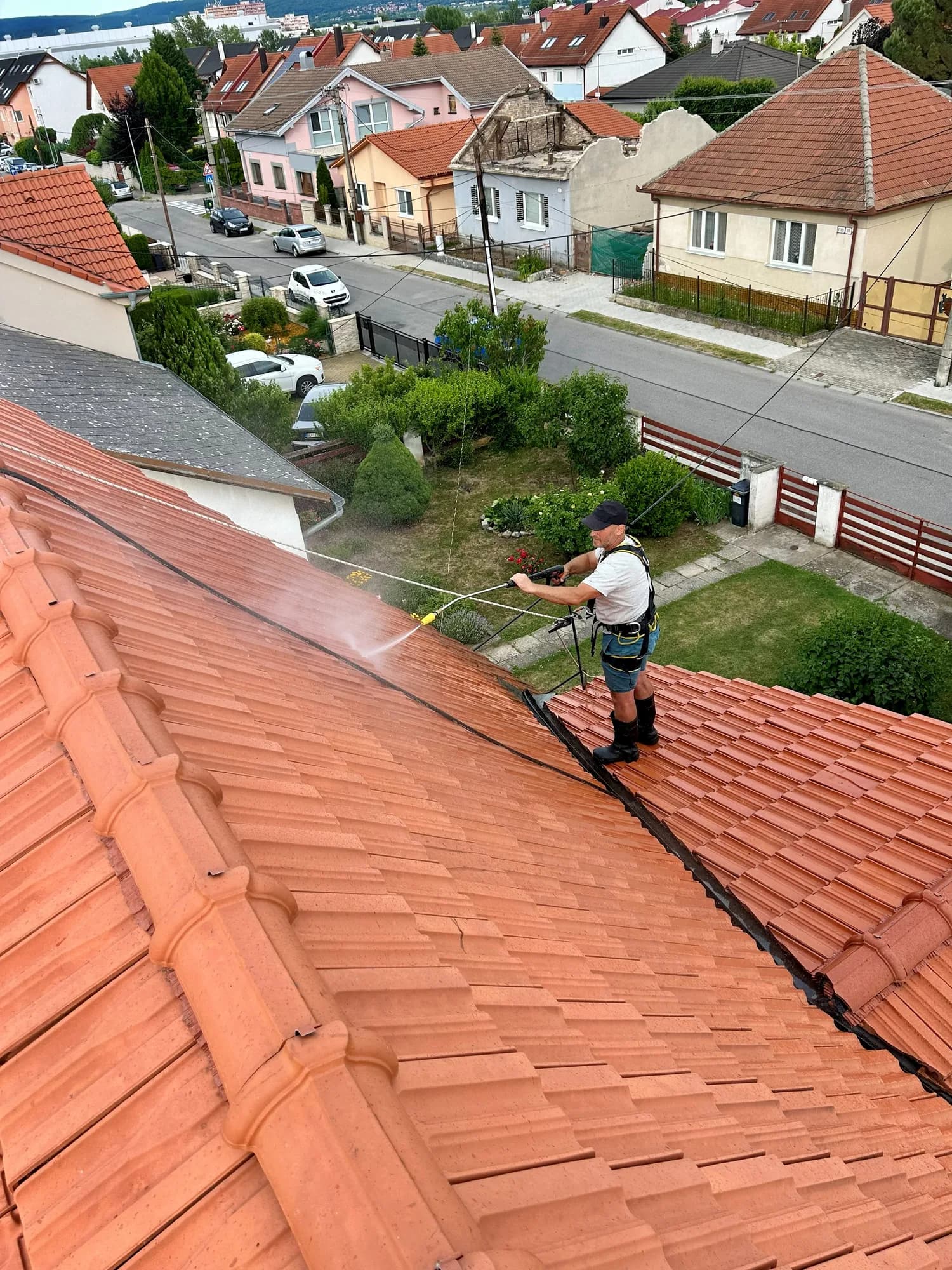
Moss on a roof looks like a cosmetic matter that can wait. In reality it is an organism that holds water on the covering, and it is long-retained water that does a roof the most harm. As long as the covering dries within a few hours after rain, nothing happens. Once saturated moss lies on it, it stays wet for days and in winter the water inside it freezes over and over.
That is why cleaning and coating are dealt with together. Cleaning alone returns the roof to its original look, but leaves the surface exactly as absorbent as it was, and the moss comes back. A coating or impregnation reduces surface absorbency, so water runs off before anything can take hold. Without cleaning, in turn, the coating has nothing to bond to.
What's included
- Moss removal from the roof, including lichen, algae and deposits lodged in the tile profile
- A method chosen for the covering, so one way for tiles, another for sheet metal, another for fibre cement
- Roof coatings and clear impregnation once the covering has dried
- Waterproofing coatings for flat roofs, including reinforced detailing
- Gutters and downpipes cleared during the same visit so roof debris does not block them
- Work from rope or a platform, so no scaffolding and no walking on brittle covering
Why moss on a roof is not merely an eyesore
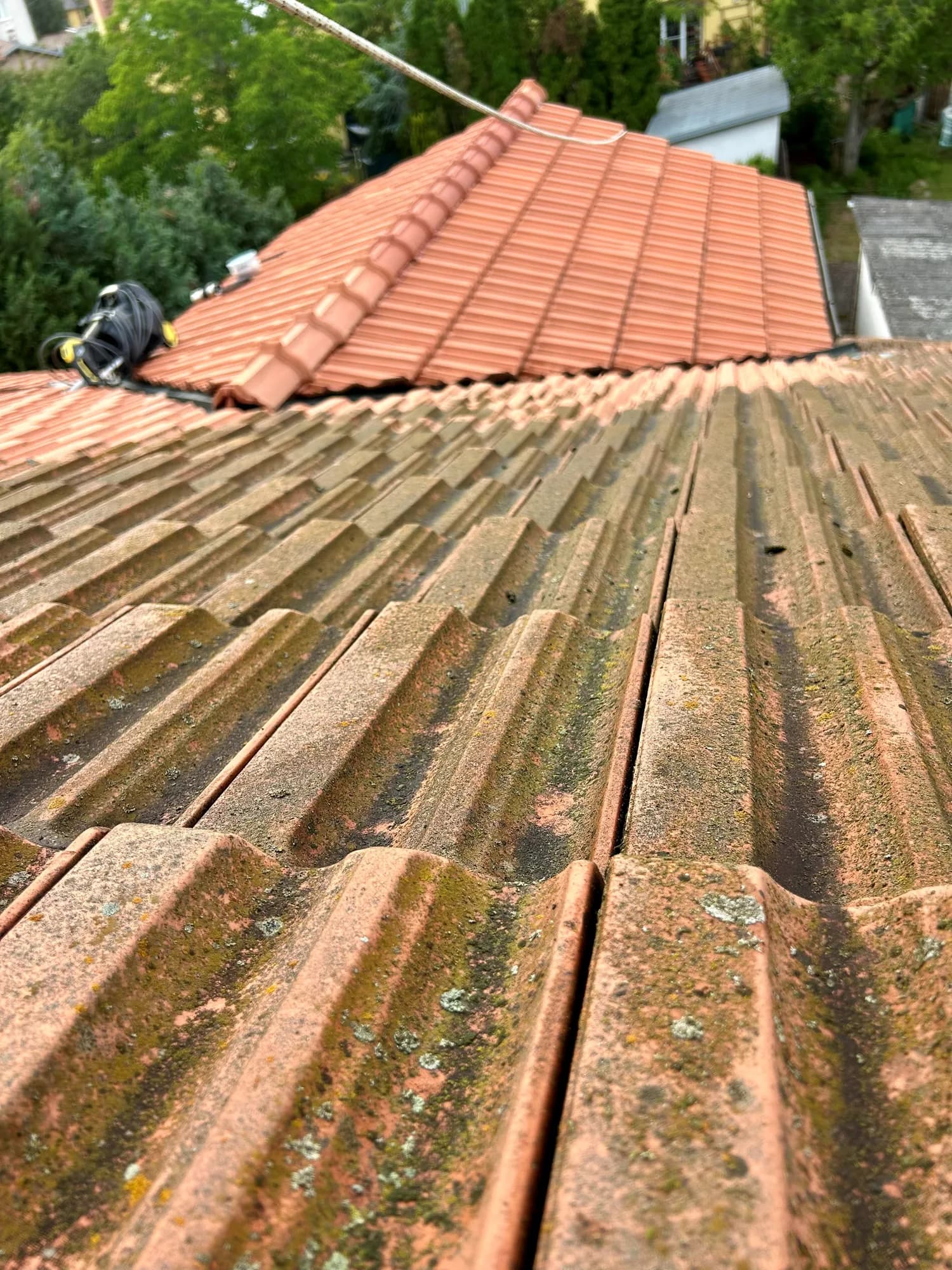
Moss works like a sponge. It holds many times its own weight in water and keeps it right on the surface of the covering long after the rain has stopped. In frost that water freezes, expands and flakes off the tile's surface layer. After a few winters the surface is rough, friable and absorbent, which speeds the moss up further.
The second issue is mechanical. Moss also grows in the overlap between tiles, where it cannot be seen. As it builds up, it lifts the tile slightly and breaks the seal of the overlap, so driven rain gets underneath the covering. The third issue is the gutters: dead moss washes down, cakes into a compact layer in the gutter, and in heavy rain the water spills over the edge straight onto the facade and down to the foundations.
How to tell your roof needs cleaning
A roof is hard to judge from the ground, because from the pavement you only see the lowest course, which is why moss cleaning tends to be ordered a couple of seasons later than it should be. Indirect signs, which you can notice without going up, are more reliable.
- Green or black growth on the north side and in the shade of trees.
- Small pieces of moss and grit in the gutter or below the downpipe after rain.
- A gutter that overflows even in ordinary rain although it seems clear.
- Pale patches on the covering, that is places where the surface has lost its original layer.
- Grey granules in the gutter guard on an asphalt shingle roof, that is washed-off mineral surfacing.
- A damp patch on the soffit or in the loft after prolonged rain.
Moss, lichen and algae are not the same thing
We distinguish them because each is removed differently. Algae form a thin greenish or black film that sits on the surface and washes off fairly easily. Moss is bulky, its rootlets are embedded in the micropores of the covering, and removing it takes a little of the surface with it. Lichen is the hardest case, it clings as if glued on and purely mechanical removal is impossible without damaging the covering.
That is exactly why lichen and heavily overgrown old coverings more often call for chemical treatment, which kills the growth at the root and lets it break down gradually, rather than tearing it off by force.
What method each covering can take
There is no single universal method on a roof. What is routine practice on a concrete tile is dangerous on fibre cement, and on asphalt shingles it damages the covering irreversibly. So the first thing we establish on a survey is not the extent of the moss but the type of covering and its condition.
| Covering | What may be used on it | What to watch for |
|---|---|---|
| Concrete tile | Pressure water at controlled pressure, then coating or impregnation once dry. | It has a thin surface layer that high pressure grinds away. Exposed concrete then absorbs more water and the moss returns faster than before cleaning. |
| Clay tile | Gentle pressure water or chemical treatment; a glazed tile usually needs only rinsing. | It is hard but brittle. Older tiles crack underfoot and the crack is often hairline, that is invisible from outside. |
| Fibre cement, commonly called eternit | Spray application and low-pressure rinsing only; on older sheets preferably no pressure at all. | Older sheets may contain asbestos. High pressure releases fibres into the air and around the house. See below in detail. |
| Sheet metal, standing seam and profiled | Pressure water, mechanical rust removal, anti-corrosion primer and top coat. | The jet must never be aimed against a seam or under a fold, as water gets beneath the covering. Watch the screw seals on profiled sheet too. |
| Asphalt shingle | Chemical treatment and a gentle rinse; mechanically no more than sweeping off loose debris. | The surface is protected by mineral granules. Pressure washes them off and the shingle then degrades in the sun. Lost granules cannot be replaced. |
| Flat roof, bitumen sheet or membrane | Rinsing and debris removal, and on bitumen sheet possibly a waterproofing coating. | The seams, outlets and parapet junctions are critical. A hard tool or sharp point on a membrane makes a hole you only discover in the first rain. |
Fibre cement and asbestos: why high pressure is out
Older fibre cement coverings, commonly called eternit here, were manufactured with asbestos fibres. As long as the sheet is intact and the fibres are bound in cement, the risk is low. The problem arises precisely when you disturb the surface: high-pressure water, sanding or a wire brush release fibres into the water and the air, and they scatter across the roof, the facade and the garden.
So we approach such a covering without pressure. A moss treatment is sprayed on and at most a mild rinse follows, or the roof is left to be finished by rain. If the covering is weathered, cracked or crumbling, the right answer is no longer cleaning but professional removal and replacement, which requires an authorised contractor and a prescribed waste-handling regime.
If you do not know when a fibre cement covering was laid, treat it as if it contained asbestos and do not attack it yourself with a pressure washer. It is a roof type where careless cleaning endangers not just you but the surroundings of the house as well.
Pressure cleaning or chemical treatment?
These are two different things with different outcomes and they are often combined. Pressure cleaning is mechanical, the result is visible the same day and it clears even heavy deposits from the tile profile. It is also the harshest on the surface and cannot be used everywhere.
Chemical treatment means spraying a product that kills moss, lichen and algae at the root. It needs no pressure, so it is gentle on brittle coverings, but the result is not immediate. The growth gradually greys, dries out and washes away with the rain over weeks or months. Anyone wanting a clean roof for a photograph in two days will not be happy with this method, even though it is kinder to the covering.
- An overgrown concrete tile roof in good condition: pressure cleaning and a coating once dry.
- Brittle, old or fibre cement covering: chemical treatment without pressure.
- Lichen on clay tiles: chemistry first, mechanical work afterwards and gently.
- Rusting sheet metal: pressure for washing, but rust is dealt with mechanically, not by water.
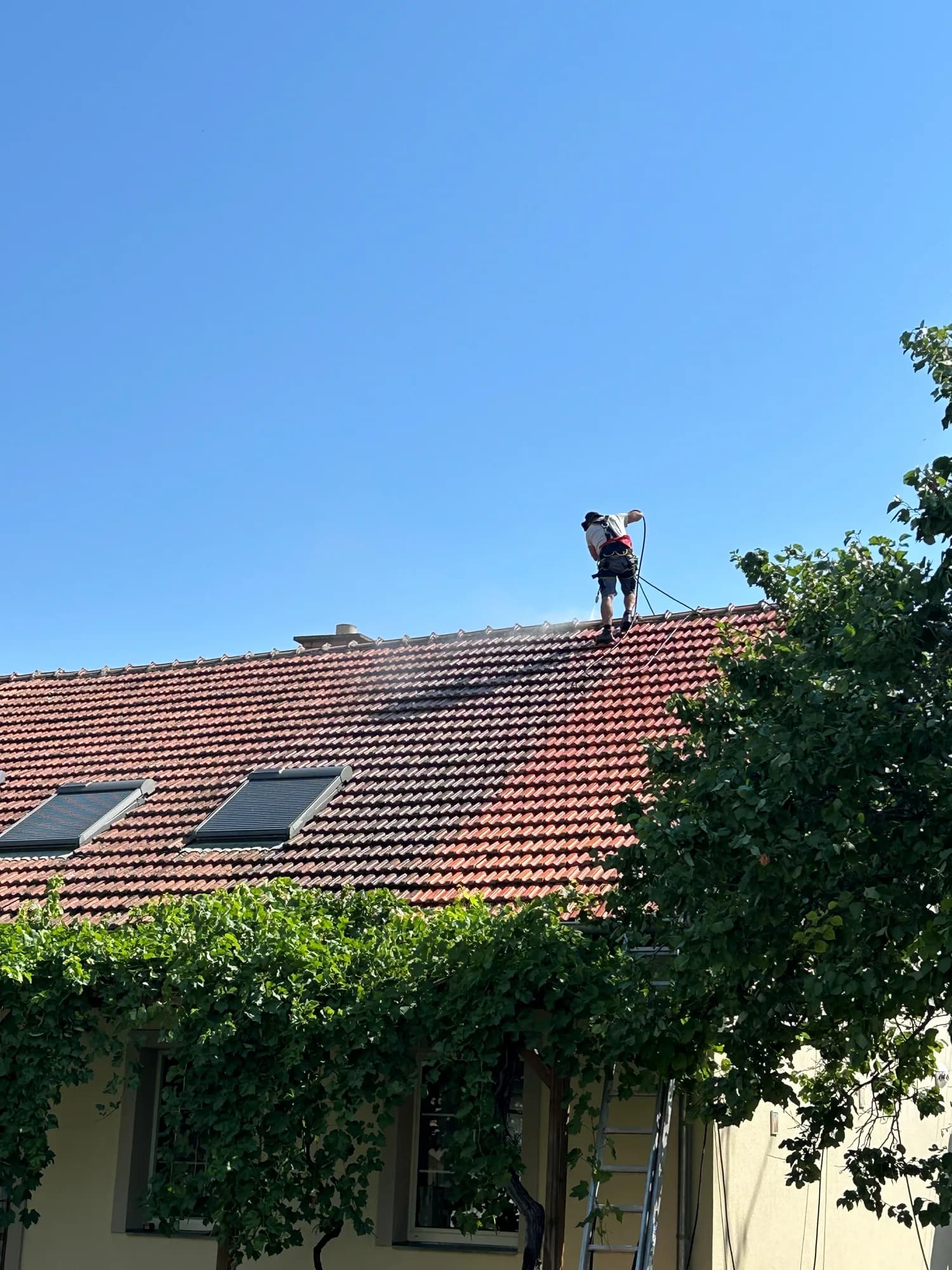
How pressure cleaning of a roof actually works
Pressure is only one of three variables. The distance of the nozzle from the surface and the nozzle type matter just as much. A rotary nozzle held close will grind the surface off a concrete tile in seconds, while a flat fan from a greater distance cleans the same tile without damage. So on the survey we trial the method on an inconspicuous spot first and set up the rest according to the result.
The second rule is direction. Work always runs top-down and with the lap of the covering, never from below against it. A jet aimed against the lap drives water under the tile onto the secondary waterproofing and, where that is damaged, into the loft. This is a common reason a roof starts leaking after DIY cleaning although it was sound before.
Chemical moss treatment and how long it takes to work
The product is sprayed onto a dry covering, ideally when no rain is due the next day, so it can soak in and act. The effect is not visible at once: the moss first turns brown and loses volume, then starts to break down. Depending on the thickness of the growth and the weather this takes weeks, and with a thick layer on the north side even a whole season.
That is why chemical treatment is often done as a second step after mechanical cleaning rather than instead of it. The bulk layer is taken off mechanically, the chemistry deals with what is left in the pores and laps, and the coating then goes onto a surface where nothing is still growing.
If you have a rainwater tank, a pond or vegetable beds under the downpipe, tell us in advance. The downpipe can be disconnected beforehand and the wash water diverted elsewhere, which is impossible to arrange after the event.
Impregnation and coating are not the same
This is the most common misunderstanding when ordering. Impregnation is a liquid that soaks into the surface and reduces its absorbency, but forms no layer on it and usually does not change the colour. A coating is a pigmented material that forms a continuous film on the surface, evens out the appearance and restores the colour. Price, preparation and service life therefore differ between the two.
| Treatment | What it does | When it makes sense |
|---|---|---|
| Impregnation | Soaks into the surface, reduces absorbency and leaves the look almost unchanged. | The covering is sound and you are happy with its colour, and you only want to slow the moss down. |
| Tile coating | Forms a coloured film, evens out a faded surface and seals it. | The tiles are faded or patchy and you want to change the look of the house without replacing the covering. |
| Waterproofing coating | Forms a continuous flexible layer that bridges fine cracks in the substrate. | A flat roof with ageing bitumen sheet where the build-up beneath is still dry. |
Roof coatings: what a coating can and cannot do
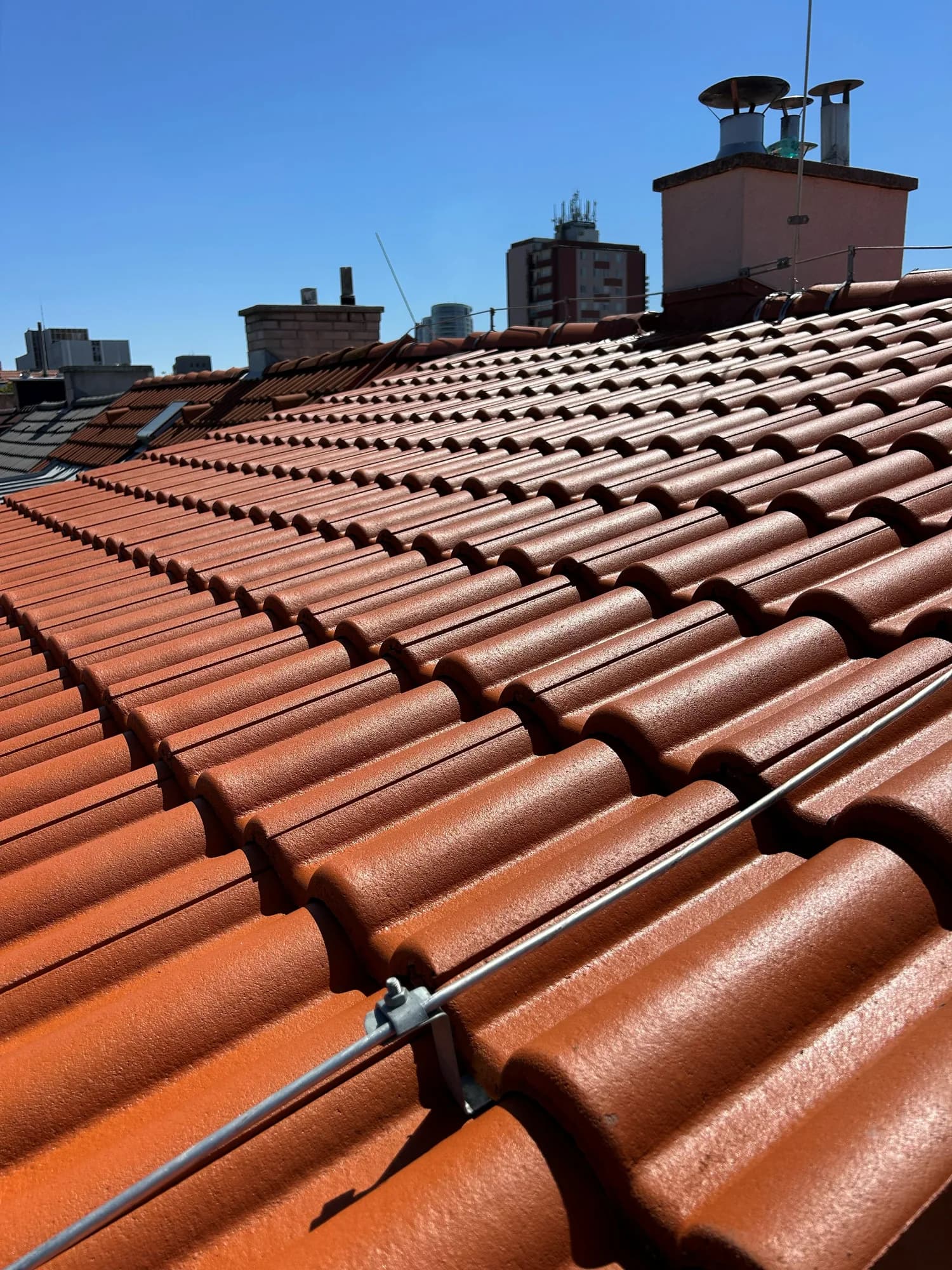
A roof coating restores colour, evens out the appearance of the surface and seals a face that has lost its original layer over the years. Those are real benefits and on a house with faded concrete tiles they show at first glance. The coating is applied in stages: a penetrating primer that consolidates the substrate, and usually two top coats.
Just as important is what a coating cannot do. It will not repair a cracked tile, will not turn a pitched roof into a waterproofing layer and will not replace damaged secondary membrane beneath the covering. If a roof leaks, a coating does not solve it, it only hides it. On a friable, unsound substrate the coating will additionally peel off after the first winter together with the layer it was holding on to.
Coating concrete and clay tiles
Concrete tile takes a coating best. It has a porous surface into which the primer keys well, and after years it is usually faded, so the difference is striking. The condition is that the tile is intact and not crumbling. If sand comes away when you run a hand over the surface, the substrate is not sound and a coating will not last long on it.
Clay tile is a different case. A glazed or engobed tile has a smooth, closed surface that an ordinary coating has nothing to grip, and there is no point forcing one onto it. Untreated clay tile can be coated, but cleaning is often enough, because it holds its colour considerably better than concrete. So on the survey we may well tell you that a coating is not worth ordering in your case.
Coating a metal roof and anti-corrosion preparation
With sheet metal it is preparation that decides, not the paint. A coating on a metal roof lasts exactly as long as the removal of rust and grease beneath it was thorough. Rust is dealt with mechanically, that is by sanding or wire-brushing back to a sound base, then comes degreasing, an anti-corrosion primer and only finally the top coat. Paint laid straight over rust does not stop it, it merely covers it for a while.
New galvanised sheet is a special case. Its surface is too smooth and chemically active for ordinary paint, so the coating peels away in sheets after a while. The fix is either a primer designed for galvanising or waiting until the surface weathers naturally. On a standing seam roof the seams and upstands, where corrosion starts first, are coated as well.
Waterproofing coating on a flat roof
A waterproofing roof coating is a liquid material that cures into a continuous, seamless, flexible layer. It is used mainly on flat roofs with bitumen sheet that still holds but is ageing at the surface, cracking and losing its granules. Its advantage is that it can be applied to awkward details around outlets, chimneys and penetrations, where sheet is difficult to torch on.
There is one condition and it is fundamental: the build-up beneath the sheet must be dry. If water has already got into the roof and the insulation is saturated, sealing the surface locks the moisture in, it evaporates in the heat and lifts the new layer into blisters. In that case a test opening must be made and the build-up addressed, not the surface. Details at the parapet, outlets and corners are reinforced with a fabric, because that is where the layer cracks first.
Why a roof must dry out after cleaning
Concrete tile absorbs a great deal of water during pressure cleaning and releases it back from depth only slowly. It feels dry to the touch within hours, yet remains damp inside for several days. If a primer or coating goes onto such a surface, moisture is sealed under the film, evaporates on the first sunny day and lifts the coating. It only shows up seasons later, when the coating starts peeling off in patches.
That is why cleaning and coating are almost always two visits with a gap between them, not a single day's work. If someone offers to clean and coat a roof in one day, ask how the drying of the substrate is handled, because the life of the coating rests on it.
What time of year roof cleaning and coating can be done
Roof cleaning can be done throughout the growing season, that is roughly from spring to late autumn, as long as there is no frost and no strong wind. Most customers tackle it in spring, when after winter they see how much moss has built up, which is why March and April slots fill fastest. Autumn is quieter and often more suitable for the work.
Coating is far more weather-sensitive. It needs a dry substrate, air and surface temperatures within the range set by the manufacturer of the particular product, and the surface must be measurably warmer than the dew point, otherwise moisture condenses on it. Nor is it applied to hot metal in direct sun, because the coating skins over before it can cure properly. So coatings are scheduled for settled weather, not for a single fine day between two fronts.
How long the result lasts
Cleaning alone without follow-up treatment is the shortest-lived option. The surface of the covering stays as absorbent as before, spores are always in the air and the moss returns, faster on a shaded north slope under trees than on a sunlit south one. The difference between two slopes of the same house is often striking.
Both impregnation and coating extend the result to a matter of years, but the actual figure depends on the roof's orientation, pitch, surrounding greenery, the quality of substrate preparation and how many layers were applied. Rather than promising a number, on the survey we tell you what specifically is loading your roof. If branches overhang it, pruning the tree will extend the result more than any product will.
Gutters and downpipes during the same visit
During roof cleaning everything loosened from the covering washes down into the gutter. If the gutters are not cleared straight after the roof, the debris settles in them, works into the downpipe and blocks it at a point that cannot be seen from outside. So gutters are the final step of every such job, not a separate order a month later.
It is also the only occasion when anyone looks at the gutter closely. While cleaning we check the fall, the tightness of joints, the fixing of the brackets and the condition of the eaves flashing. A sagging gutter or a leaking joint can be fixed in minutes while someone is up there, whereas six months later it means a separate call-out and further cost on top.
Why doing it yourself on the roof ends badly
A roof covering is not a walking surface. It is designed to carry snow spread over the whole area, not a person's weight concentrated on one spot. Clay tile cracks, concrete tile breaks at the edges, and fibre cement and old shingle on boarding simply give way. What is more, the crack is often invisible and only shows months later as a damp patch in the loft.
The second factor is wet moss. On a sloping wet covering it is as slippery as ice and there is no stopping on it, however good your footwear. The third is a ladder leaned against the gutter, which bends or tears out the brackets when weight shifts onto it. So we work with an anchor above the ridge, on rope and in pairs, and secure the area below the workplace so that neither washed-down debris nor a tool can hit anyone.
How we reach the roof without scaffolding
We use rope access, that is industrial climbing technique with two independent ropes, and where it makes sense a mobile elevating platform as well. We anchor above the ridge or into the load-bearing structure, so we reach even a steep roof that cannot otherwise be stood on, and put our weight on the rope instead of the covering.
For the customer that means two practical things. First, the cost and time of erecting scaffolding disappear, which on a one-off cleaning is usually a substantial item in the budget. Second, there is no need to close a courtyard, car park or pavement for days; we only take up the space directly below the workplace.
When cleaning no longer pays and the covering needs replacing
Not every roof is worth cleaning and coating. If the covering is at the end of its life, a coating will not add years to it, it will merely conceal its condition for one season. We think it right to say so in advance, even when it means not taking the job.
- Tiles are crumbling, the edges break and sand comes away when you run a hand over them.
- Cracks are not isolated but scattered across the whole roof area.
- The secondary waterproofing under the covering is missing or has disintegrated.
- Battens or rafters are affected by rot, which shows as sagging of the roof plane.
- The roof leaks in several places, so it is not a single damaged tile.
- A fibre cement covering is weathered and crumbling, where professional replacement is the right answer.
What drives the price of roof cleaning and coating
The price is set by the plan area of the roof adjusted for pitch, the type of covering, the thickness of the growth and whether the job is cleaning only or coating as well. For coatings the number of layers and the extent of substrate preparation are added, and on rusting metal that preparation is often a bigger item than the paint. So the price of roof cleaning can differ considerably between two houses of the same size, and the same goes for the price of coating a roof.
- Roof area, pitch and complexity, that is the number of dormers, valleys and chimneys.
- The type of covering and what method it can take without damage.
- The thickness of the growth; lichen is more laborious than a thin film of algae.
- Whether it is cleaning only, or impregnation or coating as well, and in how many coats.
- Access to the building, room to set up a platform, and availability of water and power.
- The extent of securing the area below, especially over a working premises or a pavement.
How the survey works and what we need from you
For a first rough estimate photos and basic dimensions are usually enough. On larger or complex roofs we come for a survey, because the type of covering and its condition cannot be judged reliably from a photo and the whole method depends on them.
- A photo of the whole house showing the height, pitch and access to the roof.
- A close-up of the covering, ideally including the shaded north side.
- The approximate roof area, or at least the plan dimensions of the house.
- Whether the roof leaks anywhere or you have had repairs done before.
- Whether there is a rainwater tank, pond or planting bed under the downpipe.
Where in Bratislava and the surrounding area we work
We clean roofs across Bratislava including Petržalka, Ružinov, Nové Mesto, Staré Mesto, Karlova Ves, Dúbravka, Rača, Vrakuňa and Podunajské Biskupice, and by arrangement also in Senec, Pezinok, Malacky and Stupava. Family houses in the outer districts and surrounding villages make up most of this work, because their roofs are often shaded by mature trees.
How it works
Survey and choice of method
From photos or on site we establish the type of covering, its condition and the extent of the growth, and choose accordingly between pressure, chemistry or a combination.
Cleaning and drying
We remove moss, lichen and deposits, clear the gutters and downpipes, and let the covering dry thoroughly before any coating is touched.
Coating or impregnation
We apply the primer and top coats or a clear impregnation, work through the details at the ridge and valleys, and check the finished area.
💡 The price depends on the area and pitch of the roof, the type of covering, the thickness of the growth and whether the job is cleaning only or includes impregnation or coating. Send photos and rough dimensions and we usually quote within 24 hours.
Frequently asked questions
How much does roof cleaning cost?
The price is set by the area and pitch of the roof, the type of covering, the thickness of the growth and whether it is cleaning only or coating too. Send us a photo of the roof both close up and from a distance plus rough house dimensions and we usually quote within 24 hours.
Will pressure washing damage my covering?
Set up wrongly, yes, which is why we choose the pressure, nozzle and distance to suit the covering and trial the method on an inconspicuous spot first. On asphalt shingle and older fibre cement we use no high pressure at all, only chemistry and a gentle rinse.
How often should a roof be cleaned?
It goes by condition rather than the calendar, but it is sensible to inspect the roof and gutters once a year, ideally in autumn after leaf fall. North-facing roofs and those under trees need attention considerably sooner than the sunlit south slopes of the same house.
Can a fibre cement roof be cleaned?
It can, but without pressure. Older fibre cement sheets may contain asbestos and high-pressure water would release fibres into the surroundings, so only spraying and a mild rinse are used. If the covering is already crumbling and cracking, the right answer is not cleaning but professional removal and replacement.
Does a coating have to follow the cleaning?
It does not, but without it the moss returns sooner. Cleaning removes the growth yet leaves the surface as absorbent as before, whereas impregnation or coating reduces that absorbency. On glazed clay tile, by contrast, a coating usually makes no sense and cleaning is enough.
How long after cleaning can the roof be coated?
Not the same day. The covering, especially concrete tile, holds moisture at depth for several days after it feels dry to the touch, and a coating over a damp substrate peels later. So we plan cleaning and coating as two visits with a weather-dependent gap.
What time of year are roof coatings applied?
When the weather is settled, dry and warm, so generally from spring to autumn. A coating needs a dry substrate and a surface warmer than the dew point, so it is not applied in frost, in fog or onto hot metal in direct sun. March and April slots fill first, so it pays to get in touch early.
Do you need scaffolding, water or power?
No scaffolding, we work from rope or a platform. For cleaning, access to water and power on the property is useful; if they are not available we bring our own supply, but we need to know in advance for pricing and planning.
Will you clear the gutters at the same time?
Yes, they are part of the job and always done after the roof. Debris loosened from the covering washes straight into the gutters, so clearing them earlier would be pointless. While there we also check the fall, the joints and the bracket fixings.
Related services
Need cleaning or work at height?
Get in touch and we'll prepare a tailored, no-obligation quote, usually within 24 hours.