
Services
Cleaning rainwater gutters and downpipes by rope access
Gutter cleaning means removing the build-up from gutters, hopper heads and downpipes, followed by flushing and a test of whether the water actually drains away. We do it on family houses, apartment blocks and commercial premises in Bratislava, reaching the gutters from rope or a platform, so with no scaffolding and no ladder leaning against the gutter.
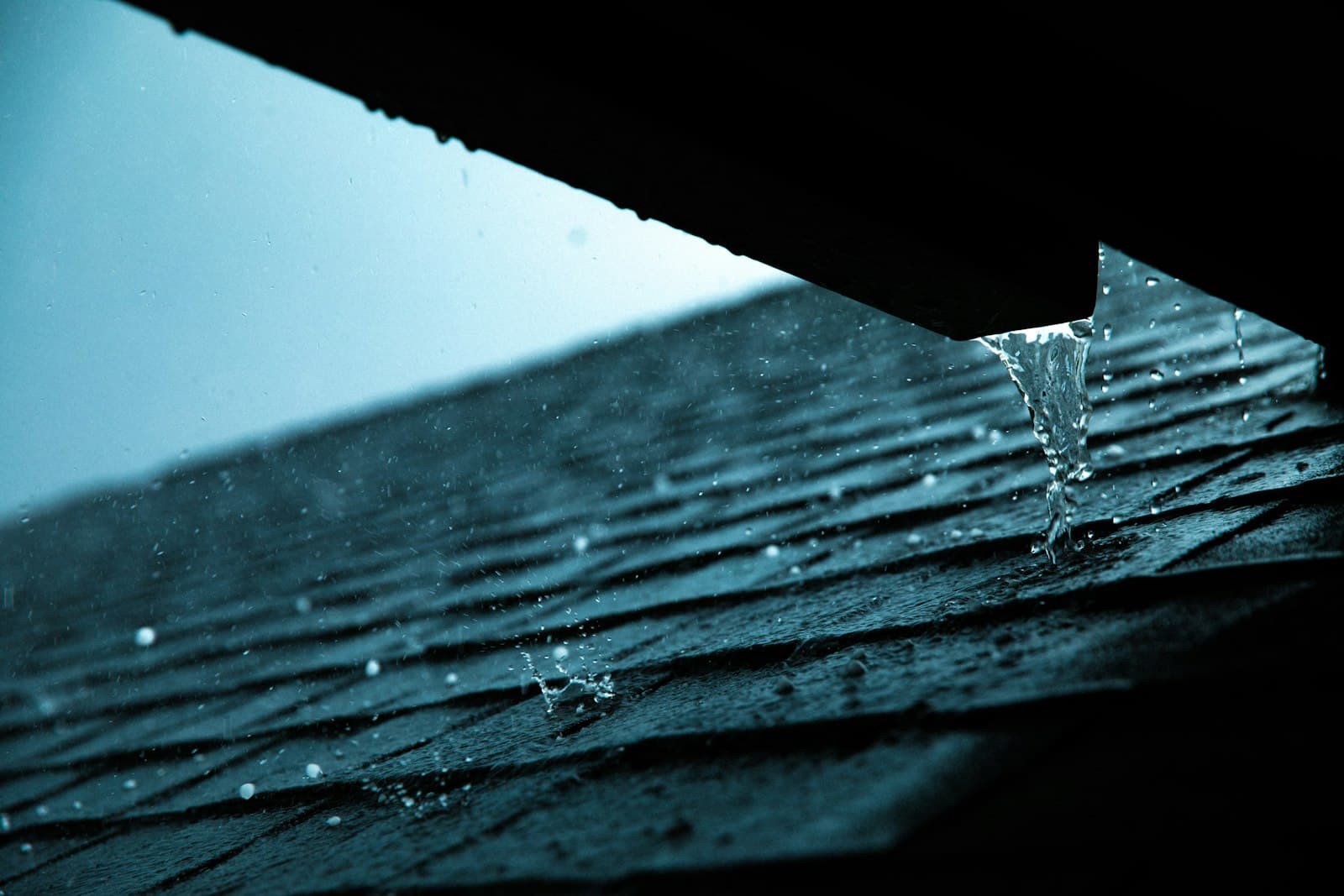
A gutter is the one part of a house that has to work exactly when nobody can look at it, that is during heavy rain. So a blocked gutter almost never announces itself. What announces it is a damp patch on the facade, render falling off near the plinth or damp in the cellar, and by then it is a repair, not maintenance.
That is why we do not treat gutter cleaning as raking out leaves. The debris has to be lifted out and taken away, the gutter and the downpipe flushed, then water run through while we watch where it goes and how fast. Only then can we say whether the system is clear or whether it has a problem that raking did not solve.
What's included
- Raking out and flushing of gutters, hopper heads and downpipes
- A water flow test at the end, not just a look into the gutter
- A check of the fall, brackets, joints and stop ends during the same visit
- Access from rope or platform, without scaffolding and without a ladder against the gutter
- We take the debris away, we do not drop it onto the terrace, garden or pavement
- Photo documentation of the places you cannot see from the ground
What actually collects in a gutter
Leaves are only what is visible. The trouble starts when organic debris soaks through, breaks down and bakes together with mineral dust into a dense mass. That no longer floats, it sits on the bottom of the gutter and behaves like a wet rag.
- Leaves from deciduous trees, which fall over a few weeks in autumn.
- Conifer needles, which drop all year round, are short and pass through almost any guard.
- Moss and algae growth, which build their own rooting layer in a shaded gutter.
- Grit shed from asphalt shingles, which washes off ageing roofing with every downpour.
- Nest material, feathers and droppings from birds that take to the gutter as a sheltered spot.
- Seeds, self-seeded saplings and sprouting shrubs, which root in the debris and force the gutter joints apart.
If grass or a small sapling is growing in your gutter, the debris has been there for several seasons and is almost certainly sitting in the downpipe bend as well.
What happens when a gutter overflows
A blocked gutter does not stop the water, it only redirects it. The water runs over the outer edge, down the facade and lands at the base of the house in one spot instead of being distributed by the downpipes. In a cloudburst the whole roof then drains in a single band onto the plinth and into the ground beneath it.
The damage then works from the top down. First a stain appears on the facade and a green film in a band beneath the gutter, then the plinth render goes damp, and in that saturated zone freezing water tears the render off. Finally the water reaches the foundation and the cellar, and that is the most expensive part of the whole chain.
- Facade: stains, green biological film and peeling paint in a band under the gutter.
- Plinth and foundation: permanently soaked masonry, salt efflorescence and render torn off by frost.
- Soffit and roof timbers: water gets behind the gutter into the timber soffit and the wall plate.
- Ground: undermined paving, washed-out soil and a wet zone that never dries out.
Why a blocked downpipe is worse than a blocked gutter
A blocked gutter overflows gradually and spreads the water along its length. A blocked downpipe does something else: the gutter fills like a bath and the whole volume looks for one way out. That is usually a gutter joint, the edge at the hopper or the gap between gutter and soffit, in other words inwards into the structure.
On top of that, a downpipe blocks in a place you can neither see nor reach. Most often that is the bend below the hopper, the offset around a cornice and the transition into the drain at ground level. This is exactly why gutter cleaning must not stop at the gutter but has to follow the whole downpipe to the outlet.
A filled gutter is also a structural problem. Water has weight, and a full gutter can pull the brackets out of the soffit, especially if they are old or corroded.
Winter: the ice that splits a gutter
In winter a blocked gutter turns into an ice mould. Water with nowhere to drain freezes in the gutter itself, expands as it freezes and forces the joints apart. That is why gutter damage shows up in spring even though the cause dates back to autumn, when the gutter was not cleaned.
The second winter phenomenon is worse still. Snow on the roof melts during the day, the water runs to the cold roof edge, freezes there and forms an ice dam. Water builds up behind it and no longer flows into the gutter but under the roof covering. A clear gutter and downpipe do not fully solve this, but they reduce it considerably.
Icicles above a pavement or an entrance are not just a winter decoration. They are a sign that water has nowhere to drain, and at the same time a risk of ice falling onto people below.
How often to clean gutters
The interval is set not by the size of the house but by what grows around it and what the roof is covered with. A house with no trees manages on one visit a year, a house under pines may need three. The table below is a decision aid rather than a rule, and the first inspection always refines it.
| Surroundings and roof covering | How often | Why that is |
|---|---|---|
| House with no trees nearby | Once a year, in autumn | Mostly dust, seeds and whatever the wind brings. The build-up is slow, but it is still a build-up and after years it forms a continuous layer. |
| Deciduous trees within canopy reach | Twice a year, in autumn and spring | Leaf fall is short and dense. Cleaning mid-fall means the rest lands after the visit and the gutter is full again within a month. |
| Conifers, pines and spruces in particular | Two to three times a year | Needles fall year-round, pass through guards and mat together in the downpipe bend into a felt that water cannot get through. |
| Older asphalt shingle or rough sheet metal | Twice a year plus a check after a storm | Ageing roofing sheds grit that settles in the gutter like wet sand and silts up the bottom of the downpipe. |
| Building next to a construction site or busy road | Usually twice a year, depending on dust levels | Fine dust binds with water into a layer that moss takes hold of, and the moss then holds the whole deposit together. |
| Apartment block with a flat roof and outlets | Twice a year and always before winter | A flat roof has nowhere to overflow. If an outlet blocks, water stands on the roof and loads the structure. |
The best time of year for gutter cleaning
There are two worthwhile dates and one that solves nothing for most of the year. The first is late autumn once the last leaves are down, usually from the end of October into December. That is when the gutter is being prepared for winter, and it is the one period when the deposit is at its worst and can still be removed.
The second is early spring, before the wetter months. Over winter the gutter collects whatever fell after the autumn visit plus whatever blew in, and a spring check also reveals the damage frost has done. Cleaning in mid-summer makes sense only as a response to a specific problem.
If only one visit a year is possible, make it in autumn after the leaves are down. It is winter that turns a blocked gutter into a damaged one.
How gutter cleaning works and why raking is not the end of it
Raking out is the first half of the job. We lift the debris out by hand into a bucket or bag so it does not land on the terrace, the garden or the pavement below, and we take it away. Tipping the contents of the gutter over the side is the quickest option and also the one that leaves the customer clearing up and part of the debris in the storm drain.
The second half is flushing and a flow test. We flush the gutter and the downpipe, run water through and watch at the outlet whether it flows at full bore or only weakly. A weak flow means something is still in the pipe, and then the downpipe is cleared further, mechanically rather than by looking down it from above.
- Debris lifted out by hand into a container, not thrown down from height.
- Cleaning of the hopper and the downpipe inlet, where debris catches first.
- Flushing the gutter along its whole length from the far end towards the downpipe.
- Clearing the downpipe including the bend where flushing alone is not enough.
- A flow test and a check of the outlet at ground level or into the drain.
Gutter fall and what standing water means
A gutter is not level, it falls slightly towards the downpipe, in the order of millimetres per running metre. That fall does all the work: it moves water and fine debris towards the outlet. Where the fall is missing, the gutter still drains but the debris stays put and accumulates faster.
That is why standing water is an important finding. If water is still sitting in the gutter a day after rain, the issue is shape, not dirt. Either the gutter is hung wrong or it has sagged where a bracket is missing or has worked loose, or where ice loaded it in winter. Cleaning such a gutter postpones the problem rather than removing it.
We can document standing water during cleaning and pinpoint where the gutter has sagged. Re-hanging a section or adding brackets is then a separate job we can carry out on the same access.
What we check on brackets, joints and stop ends
Once you are up at the gutter, looking only at the debris is a waste. Gutter system failures tend to start at a joint or a fixing, and at an early stage a small intervention deals with them. A year later it is a section replacement.
- Brackets: whether any are missing, pulled out, bent or corroded.
- Joints and seals: whether they have opened up, whether they drip and whether there is a trace of seepage.
- Stop ends at the extremities, which most often get torn off by ice pressure.
- The hopper and the downpipe connection, the point with the greatest flow and the greatest wear.
- Downpipe clips on the facade, which loosen over the years so the pipe vibrates in rain.
- Internal corrosion on galvanised steel, where debris holds moisture permanently against the surface.
Leaf traps, guards and gutter covers
The question of whether a gutter cover is worth it has an awkward answer: it depends on what falls into your gutters. Covers deal with large leaves and almost never deal with needles and seeds. And none of them means you never need to go back to the gutter, they only change how often and why.
| Solution | When it helps | When it makes things worse |
|---|---|---|
| Wire leaf trap in the downpipe inlet | Where large leaves fall that would block the bend. It catches them where they can be lifted out. | Left unchecked it silts up itself, and the gutter then overflows along its whole length rather than just blocking the downpipe. |
| Mesh or perforated gutter guard | With heavy leaf fall and where access for checking is straightforward. | Needles and seeds pass in through the holes but cannot get back out. The debris under the cover never dries and the cover has to come off for cleaning. |
| Brush inserted into the gutter | As a cheap temporary fix on a short problem section. | Debris lodges between the bristles, the brush soaks up water, and in winter it freezes solid along with it. |
| Solid cover with a surface-tension edge | On long straight runs with light leaf fall and a shallower roof pitch. | In a cloudburst the water runs straight over the edge past the gutter and lands at the base of the house, exactly where it should not. |
| No cover, but regular inspection | In most cases, provided access to the gutters is arranged. | Only when the inspection is forgotten for years. Then it is the worst option of all. |
A gutter cover is not a bad thing, it is just sold as something that frees you from maintenance. It does that about as well as a cooker-hood filter frees a kitchen from grease.
Why cleaning gutters off a ladder does not pay
Cleaning gutters off a ladder brings together every risk factor that work around a house can gather at once. The ladder leans against the roof edge or against the gutter itself, stands on wet or soft ground, the person works with both hands and reaches sideways to avoid moving the ladder so often.
Leaning the ladder on the gutter itself is a double problem. A gutter is not a load-bearing element, under point loading it deforms or works free of its brackets, and at that moment the ladder starts to slide sideways. That is precisely why we reach gutters from a rope above or from a platform, where the operative is secured and has both hands free.
A single-storey extension or garage with the ladder on firm level ground is a different situation from the second floor above a paved yard. What decides it is not resolve, but where you would land.
How we reach the gutters without scaffolding
On an apartment block, on a building with an overhanging parapet, or anywhere nothing can be erected beneath the roof, rope access is the simplest route. We work from above, move continuously along the whole gutter run and need neither a pavement closure nor entry into flats. On lower buildings with sound ground for the wheels, a platform is faster.
The difference is mainly time. Scaffolding around the house never pays for a few dozen metres of gutter, whereas cleaning the gutters on an ordinary family house is usually a matter of a day or less. On a larger apartment block it is worked out from the gutter length and the number of downpipes.
Birds and nest material in the gutter
A gutter is an attractive spot for birds: sheltered, narrow and hard for cats to reach. The problem starts when nest material, feathers and droppings stay there, because that is exactly the sort of debris that soaks up water and forms a solid plug at the downpipe inlet. It is also unpleasant hygienically and should not be swept out dry.
If the birds return to the same spot every year, cleaning the gutters is only repeatedly treating the symptom. Then it makes sense to add barriers, that is bird protection where they perch and nest. We do not remove an occupied nest of a protected species.
What the same visit reveals about the roof
At the gutter the operative is on exactly the edge from which most of what cannot be checked from the ground becomes visible. So we photograph what we see on the way, even where it has nothing directly to do with cleaning the gutters. Alongside the cleaning the owner gets a survey of the roof edge that would otherwise have to be ordered separately.
- The condition of the roof edge flashing and verge trim, the first places water gets in.
- The parapet capping and its fall, that is whether water goes onto the roof or over the edge onto the facade.
- Slipped, cracked or missing pieces of roof covering near the edge.
- Moss and algae on the covering, which hold moisture and feed the deposit in the gutter.
- The state of the soffit and whether the timber in the band under the gutter is soaked or attacked.
- Chimney and penetration flashings, the details that let water into the roof and cannot be checked from the ground.
Flat roofs: roof outlets instead of gutters
Apartment blocks and commercial premises often have no conventional gutter but roof outlets routed inside the building. The principle is the same, but the consequence of a blockage is worse. A pitched roof lets a blocked gutter spill over the edge, a flat roof has nowhere to spill, so the water stands and loads the structure.
So on flat roofs we clean the outlets, the debris guards and the area around them, check whether they are overgrown with moss or silted with gravel, and again finish with a drainage test. It matters most before winter, because a frozen outlet means that snow melting during the day has nowhere to go.
What drives the price of gutter cleaning
The price is set mainly by the length of gutter, the number of downpipes and the access method. The second factor is the state of the deposit, because dry leaves come out differently from a compacted, mossy layer of several years that has to be broken up piece by piece. That is why two houses of the same size can differ considerably.
- Running metres of gutter and the number of downpipes to flush and test.
- Height, and whether the work can be done from rope, from a platform or only from scaffolding.
- Roof complexity, the number of corner runs, dormers and changes of gutter direction.
- The volume and state of the deposit, that is fresh leaf fall versus old compacted material.
- Whether a blocked downpipe also needs clearing, which is a separate job beyond the gutter.
- Access to the building, whether a platform can be set up, and the need to secure the area below.
Where in Bratislava we clean gutters
We work across Bratislava including Petržalka, Ružinov, Nové Mesto, Staré Mesto, Karlova Ves, Dúbravka, Rača, Vrakuňa and Podunajské Biskupice, and by arrangement also in Senec, Pezinok, Malacky and Stupava. Family houses in older districts with mature trees make up the largest share of gutter cleaning work, followed by apartment blocks with flat roofs and internal outlets.
How it works
Survey and choice of access
We establish the gutter length, the number of downpipes and whether we reach the gutter from rope or from a platform.
Raking out and flushing
We lift the debris into a container and take it away, then flush the gutter, hopper and downpipe along their full length.
Flow test and inspection
We run water through and watch the outlet, check the fall, brackets and joints, and send photos of what we found.
💡 The price depends on the gutter length, the number of downpipes, the height and access method and the state of the deposit. Send a photo of the house and the approximate gutter length and we usually quote within 24 hours.
Frequently asked questions
How often do gutters need cleaning?
One to three times a year depending on what grows around the house. A house with no trees manages on one autumn visit, a house near deciduous trees needs two, and a house under pines up to three, because needles fall all year. The first inspection refines the interval once we see how much debris has collected.
How much does gutter cleaning cost?
The price comes from the gutter length, the number of downpipes, the height and access method and the state of the deposit. The gap between fresh leaves and a compacted layer several years old is usually bigger than the gap between two houses. Send us a photo of the house and the approximate gutter length and we usually quote within 24 hours.
How do I know a gutter is blocked when I cannot see it?
From what happens during rain and beneath the gutter. Water spilling over the gutter edge instead of going down the pipe, a silent downpipe in heavy rain, a wet band on the facade, green film under the gutter, grass growing out of the gutter, or icicles at the roof edge in winter are all reliable signs. Just look at the house from outside during the first heavy rain.
Do you clean the downpipes too, not just the gutters?
Yes, and it is a substantial part of the job. A downpipe most often blocks at the bend below the hopper and at the transition into the drain, that is where you cannot see. We flush the pipe, run water through and watch the outlet. If it does not run at full bore, we clear it mechanically until the flow is restored.
Do you need scaffolding or roof access?
No, we do not need scaffolding. We reach gutters from a rope above or from a platform below, depending on the height and on whether there is room for a platform. For rope access we need anchor points on the roof or parapet, and we assess their suitability during the survey.
What is the best time of year to book gutter cleaning?
In autumn once the leaves are down, usually from the end of October into December. That is when the gutter holds the most and when it is being readied for winter, which turns a blocked gutter into a damaged one. The second sensible slot is early spring before the wetter months, which also shows what the frost has done.
Are gutter guards and leaf traps worth it?
It depends what falls into your gutter. Against large leaves they help, against needles and seeds they effectively do not, as those pass in through the holes and cannot get back out. No cover replaces inspection, it only changes the reason for it, and most covers have to be removed for cleaning.
What if the gutter is sagging, rusted through or torn away?
We document the finding and tell you what it needs. Adding or replacing brackets, re-hanging a sagging section, sealing a joint or refixing a loose downpipe can be done on the same access, but it is a separate job beyond the cleaning. We do not replace whole gutter systems.
Do you clean gutters on apartment blocks and flat roofs too?
Yes. On apartment blocks the work is priced by gutter length and downpipe count and is usually ordered by the building manager or the owners' association. On flat roofs we clean the roof outlets, their debris guards and the surrounding area instead of gutters, and again finish with a drainage test.
Related services
Need cleaning or work at height?
Get in touch and we'll prepare a tailored, no-obligation quote, usually within 24 hours.