
Services
Cleaning of windows, glazing and blinds at height
Window cleaning at height means cleaning glazed surfaces on upper floors and tall buildings that cannot be reached safely from a ladder or a windowsill. We do it by rope access, from a platform or with a water-fed pole using deionised water, for apartment blocks, offices, commercial premises and family houses in Bratislava and the surrounding area.
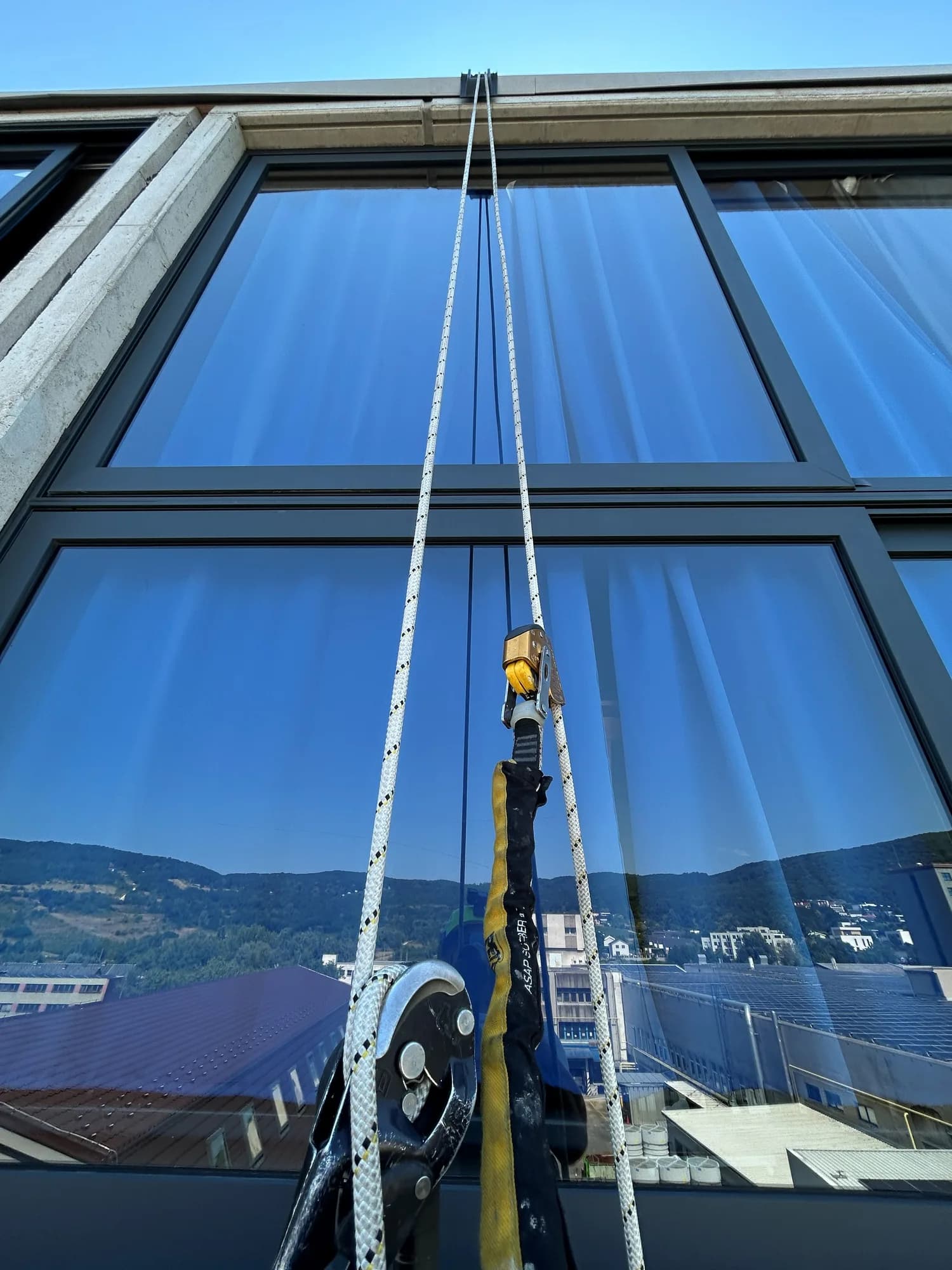
Clean glass affects two things at once: the impression a building makes and the amount of daylight inside. Neglected glazing lets in noticeably less light than clean glazing, and on the north side, where damp and algae persist, the difference is the greatest. On upper floors, window cleaning is work at height with everything that entails, meaning fall protection, prepared access and a secured area beneath the work.
We clean windows on apartment blocks and office buildings, glazed entrance portals, shopfronts, winter gardens, skylights and glass canopies. On large areas we work with water stripped of its minerals, which dries without deposits, so the glass does not need wiping dry. By arrangement we also clean frames, sills, insect screens and blinds.
We do not only do one-off cleans. For shopfronts, glass facades and the common areas of apartment blocks, an agreed interval makes far more sense, because regularly cleaned glass is faster and cheaper to service than glass on which grime has been bonding for a year.
What's included
- Window cleaning at height by rope access, from a platform or with a water-fed pole
- Deionised water, so the glass dries without limescale deposits
- Apartment blocks, offices, shopfronts, skylights and winter gardens
- On request also frames, sills, insect screens and blind cleaning
- Post-construction cleaning including mortar residue and stickers
- Scheduled regular service at an agreed interval, also outside opening hours
What we clean and on which buildings
Glazing is not just a flat window. One building usually carries several types of glass, each of which gets dirty differently and each of which is cleaned differently. That is why at the survey we ask not only about the area, but also about the type of glass and whether it opens.
- Flat and office windows, outside and inside, including fixed panes.
- Glass facades and fully glazed corners of office buildings.
- Glazed entrance portals, lobbies and glass balustrades.
- Shopfronts of shops, businesses, showrooms and restaurants.
- Skylights, glazed canopies, atria and winter gardens.
- Stairwell windows, glass-block walls and glazing in common areas.
- Frames, sills, drip trims, insect screens and blinds.
Why glass dries into streaks after washing
Streaks do not come from wiping the glass badly. They come from what stays on the glass after washing. In most cases it is one of four causes, and all four can be dealt with once you know what to look for.
- Hard water. Once it evaporates, dissolved calcium and magnesium salts stay on the glass and form a dull haze or rings where drops sat.
- Detergent residue. Surfactant that was not fully removed attracts moisture and dust, so the glass looks grey again within days.
- Direct sun and warm glass. The water evaporates before you can pull it off and dries in bands shaped exactly like the squeegee stroke.
- A worn squeegee rubber. A nick or a rounded edge leaves a thin trail of water behind it, which dries as a line across the whole pane.
The most common household mistake is wiping the glass dry with a cloth or newspaper. That does not remove the dirt, it just spreads it, which is why the streaks appear the moment the sun hits the pane from the other side.
Hard water in Bratislava and limescale on glass
The water in Bratislava's mains is fairly hard, meaning it carries a good amount of dissolved calcium and magnesium salts. That is no problem for drinking, but it is for glass. Every drop that dries on the pane leaves a microscopic ring of mineral behind, and when that repeats for months the result is a dull film visible in more than just raking light.
The worst spots are those where water drips onto the glass from something else: an air-conditioning unit above the window, a blocked drip trim, the balcony above you or terrace irrigation. There the limescale does not form evenly but in bands and patches that ordinary washing will not lift.
If such a film is left for years, the mineral gradually works into the surface and the glass starts to etch. At that point neither water nor a squeegee helps; it takes an acidic limescale remover or mechanical polishing, and even that may not restore the pane. With hard water it is therefore better to clean more often than to clean harder.
Deionised and reverse-osmosis water: why it dries without deposits
Deionised water is water from which the dissolved mineral salts have been removed. It passes through a filter medium that binds calcium, magnesium and the other ions, so what comes out of the hose is water almost free of anything that could be left behind on glass. When it dries, it simply evaporates and leaves nothing.
Reverse-osmosis water works on a related principle. Water is forced through a semi-permeable membrane that captures most of the dissolved solids. In practice the two stages are often combined: the membrane removes the bulk and the deionising cartridge polishes off the rest. Water purity is checked continuously, because the cartridge saturates over time and stops working without any visible sign.
That has one practical consequence: with pure water the glass is deliberately not wiped dry. The brush loosens the dirt, the pure water rinses it away and the surface is left to dry on its own. That is what makes it possible to clean glass you cannot reach by hand, for example from a pole at ground level or across large glass facades.
A DIY-store pole connected straight to a garden hose does the exact opposite. Without a filter, hard water goes onto the glass and dries into a limescale haze across the whole pane, leaving it worse than before.
Squeegee, pole, rope or platform: what is used when
The access method is not a question of kit but a question of the specific window. Height decides, along with whether the window opens, how much space there is around it and whether there is anything on the roof to anchor to. On a single building two or three methods are therefore routinely combined.
| Method | Where it fits | Where it hits its limit |
|---|---|---|
| Hand cleaning with a squeegee | Openable windows within arm's reach, interiors, ground floors, shopfronts, lobbies and anywhere you can stand firmly on the ground. | The outer face of fixed panes and anything you would have to lean out for or stand on a sill to reach. |
| Water-fed pole with pure water | Family houses, lower floors of blocks, shopfronts and glazed entrances, that is surfaces roughly up to three or four storeys. | Stronger wind, spots you cannot see from below, and baked-on deposits that must be softened and removed by hand. |
| Rope access | Glass facades, upper floors of residential and office buildings, fixed panes, narrow lanes and courtyards. | Anchor points or another roof-level fall-protection solution are needed, and the date is planned around the weather. |
| Powered platform | Glazed canopies, atria, entrance portals, sloping surfaces and buildings with nothing to anchor to from above. | It needs a firm, clear standing area, which is a problem in the city centre, on grass and above underground car parks. |
Cleaning your own windows versus hiring a service
The honest answer is that for a good share of windows you do not need a company. Openable windows in a flat or a house that you can reach without standing on a sill or leaning out are perfectly fine to do yourself. A decent squeegee with an unworn rubber, a microfibre cloth, very little detergent and an overcast day are enough.
What home solutions cannot handle is above all access. A robotic glass cleaner will do a large flat pane from the inside, but it will not solve frames, corners, heavy soiling or the outer face at height. A pole without water filtration leaves a limescale haze on the glass. And a ladder leaned against the facade is, above the first floor, a risk that clean glass does not justify.
Professional window cleaning therefore pays off exactly where DIY stops: fixed glazing, upper floors, large areas, post-construction work, shopfronts that need frequent cleaning, and anywhere someone is responsible for the building and needs the work at height insured and documented.
Window cleaning on an apartment block and who orders it
On an apartment block two things need separating. Glazing in common areas, meaning stairwell windows, glazed entrance portals, lobbies, skylights and glass-block walls, counts as a common part of the building. Cleaning it is decided by the manager or the owners' association and is usually paid from the operation and maintenance fund.
The windows of individual flats are ordered by the owner. In practice, though, it pays to combine them. If several flats in one entrance sign up at the same time, the ropes are rigged once, the access is prepared once, and a single window works out noticeably cheaper than a separate visit for the same flat.
For building managers we prepare the quote in a form that can be put to a meeting or a written vote, and we can tie the date to other work on the building, such as a gutter check or facade cleaning. We carry third-party liability insurance and send the certificate with the quote.
Glass facades of office buildings and scheduled service
On a glass facade you do not clean window by window but area by area, and logistics decide. You need to know where the roof anchors are, how the area beneath the work can be secured, whether work is allowed during office hours and whether the facade has features on which a rope could snag or chafe.
Most of our work of this kind is repeat work planned in advance. The reason is not convenience but cost and result. A facade cleaned at an agreed interval is faster to service, because the dirt has no time to bake into a film, and it does not need aggressive chemistry that in the long run attacks seals and frames.
- We can work early morning or at weekends so as not to disturb operations.
- The area beneath the work is fenced and signed for as long as work continues above it.
- We can meet the building management's requirements on access and documentation.
- The interior face of the glazing is handled separately, usually outside working hours.
Shopfront cleaning: frequency decides, not effort
A shopfront is the dirtiest glass in town and at the same time the most visible. In one day it collects handprints, children's and dogs' noses, dust and exhaust from the street, road salt in winter and, at food premises, grease from the extraction. Customers register it even without realising, a dirty shopfront lowers the impression of the business before anyone walks in.
In practice, with shopfronts it is not the thoroughness of one clean that decides but the interval. Loose dust washes off with water. Left on the glass for weeks, however, it combines with grease and exhaust into a continuous film that must then be dissolved and removed mechanically, which takes considerably longer. Weekly shopfront cleaning therefore often works out cheaper in total than a deep clean twice a year.
If your glass carries printed vinyl or film, tell us in advance. Vinyl is not cleaned like glass; scrubbing and a blade lift its edges and the film starts to peel.
Skylights, glazed canopies and winter gardens
Horizontal and sloping glass gets dirty differently from vertical glass. On a vertical pane the water runs off; on a skylight or canopy it stands and evaporates together with whatever it carried. Deposits on these surfaces are therefore harder, and algae and moss take hold faster, especially at the frame edge where damp lingers.
Safety is fundamental. A skylight is not a walkable surface even when it looks like one, and acrylic or older polycarbonate glazing becomes brittle after years in the sun. So we do not step on skylights; we work above them on fall protection from above or from a platform.
A winter garden has an additional problem from the inside. Moisture from the plants condenses on the inner face of the glass, dust settles on it and a green film takes hold in the seals. Both the glass and the seals are therefore cleaned from both sides, otherwise cleaning only the outside shows half a result.
We have cleaned glass canopies at Eurovea, for example. It is the type of surface where everything shows up at once: horizontal glass, heavy footfall underneath and the need to work so that nothing falls on anyone below.
Cleaning blinds, external and internal
Cleaning blinds is a separate job and cannot be dealt with by washing the window. A slat has a large surface and a small footprint, dust clings to both sides of it, and on external blinds it turns, with the help of rain, into a bonded film. If the blinds are not cleaned along with the window, the first time they are raised the grime runs down the clean glass.
The common rule for every type is simple: clean slat by slat and never spray water into the top box with the winding mechanism. A pressure washer is unusable on blinds; it bends slats, damages the coating and forces water into the mechanism, which then starts to squeal and rust.
| Type of blind | How it is cleaned | What to watch for |
|---|---|---|
| External aluminium blinds | Slat by slat with a soft brush and a mild agent, then rinsed with pure water. On upper floors from rope or a platform. | A slat bends easily and once bent it no longer seats properly. Water must be kept out of the top box and the guide rails. |
| Internal aluminium blinds | With a damp cloth along each slat, catching the drips below the blind. | The dust is often mixed with cooking grease, so a dry cloth alone merely spreads it. |
| Fabric vertical blinds | Vacuuming the dust, then foam or spot cleaning with attention to the bottom edges of the vanes. | Soaking shrinks and ripples the fabric, and the bottom weights and chains can rust. |
| Wooden and bamboo blinds | Dry or almost dry, with a barely damp cloth and wiped dry immediately. | Water raises the timber, the lacquer cracks and the slat warps. That damage is permanent. |
| Screen and fabric external shading | Gently, with minimal water and no scrubbing, usually while unrolled and dried before being rolled up. | Damp fabric rolled up will mildew. An aggressive agent damages the fabric's surface treatment. |
If external blinds will not raise or move stiffly, tell us before the clean. A jammed blind usually means a problem in the guide rail or the tape, and that should be sorted before water goes anywhere near it.
Frames, sills and window drip trims
Clean glass in a dirty frame looks poor and does not last either. At the first rain, water from the frame runs down the pane and creates exactly the streaks you wanted rid of. So we clean the frame and sill together with the glass whenever that is part of the job.
White plastic frames often develop small dark spots. That is not dust but micro-organisms lodged in the pores of the surface, and ordinary wiping will not remove them. They can be cleaned with an agent intended for plastics, but never with an abrasive. A roughened plastic frame then soils faster and next time the work is worse still.
The last thing people forget is the drip trim under the window and the drainage on the sill. Once it clogs with leaves or moss, water stops dripping clear of the facade and starts running down it. The result is dark streaks under every window, which are no longer a window-cleaning matter but a facade-cleaning one.
Insect screens
An insect screen is a fine sieve that catches pollen, dust and street fumes. After a season it lets through noticeably less light and air, and when it rains the dirt washes off it straight onto the glass. So screens are always taken off when windows are cleaned, otherwise the outer face cannot be done properly.
They are cleaned by removal and rinsing, not by scrubbing in place. Brushing a fitted screen pushes the dirt into the window and stretches the mesh, which then ripples in its frame and no longer seals. When we take them off we label them, because within one flat the frames often differ by a few millimetres and, once swapped, will not fit back.
Window cleaning after construction and refurbishment
Post-construction window cleaning is a different job from routine window cleaning and is priced differently. What is on the glass is not dust but residue that stuck or dried onto it: cement laitance, mortar, plaster, silicone, paint, expanding foam, adhesive from protective film and factory stickers. An ordinary wash will not shift any of it.
The method is slower and more careful. The surface is first soaked thoroughly so hard particles loosen and float, and only then is a blade used, always on wet glass, at a low angle and in one direction. A blade on dry glass is the surest way to scratch it, and scratched glass cannot be brought back.
The reason not to put it off is chemical. Run-off from fresh concrete and mortar is alkaline and, left on glass for months, it begins to etch the surface to a haze. Residue from facade grinding does the same. Windows cleaned right after the build can be returned to their original state; after a year, not always.
If building work is still going on, it makes sense to wait until it finishes, or at least until facade work does. A clean window under continuing grinding is dirty again within a day.
Scratched glass and what causes it
Scratches cannot be washed out of glass. It is worth knowing that in advance so they can be told apart from dirt and nobody attributes them to the work just done. That is why, before a post-construction clean or on older glazing, we inspect the glass and point out existing damage.
- Sand and hard particles under a squeegee or cloth. By far the most common cause, which is why glass is flushed first and only then squeegeed.
- A blade used on dry glass, at a steep angle, or dragged back and forth.
- Construction debris that has already baked on, especially mortar residue and spatter from grinding or welding.
- Coated glass, for example self-cleaning, metallised or reflective, where the coating is damaged even by things ordinary glass shrugs off.
If your glazing is coated or filmed, tell us. On such glass no blade or abrasive is used and it is cleaned by soft methods only.
How often to clean windows
There is no single interval for everything. Location, the nature of the premises and what sits above the window all decide. A window on a busy road soils far faster than one in a courtyard, and glazing under a parapet that sheds water needs more attention than identical glass a floor below.
| Building type | Usual interval | Why that often |
|---|---|---|
| Flat and family house | Twice a year, in spring and autumn. | Spring removes winter dust and salt, autumn takes off pollen and summer grime before the damp season. |
| Apartment block, common glazing | Once or twice a year. | Stairwell glazing soils slowly, but the skylight and entrance portal are seen every day. |
| Office building with a glass facade | Two to four times a year. | A large area, a representative role and tenants who notice the view every day. |
| Shop or business shopfront | Weekly to monthly. | Handprints and traffic dust cannot be waited out, and dirt baked into a film costs more to remove. |
| Skylight, canopy and winter garden | Once or twice a year, depending on nearby trees. | Water stands on horizontal glass and algae and organic matter take hold on it faster. |
Weather: rain, sun and frost
A common belief is that rain dirties windows, so cleaning before it is pointless. In fact clean rainwater does not soil glass. What soils it is the dirt the rain washes off the frame, the sill, the parapet and the facade above the window, which is exactly why we clean the frame and sill together with the glass.
Worse than rain is direct sun on the glass. The water evaporates before it can be pulled off and bands are left behind. So on a building we follow the sun, cleaning whichever side is currently shaded, and in high summer we prefer to start early in the morning.
Windows are not cleaned in frost. Water freezes on the glass faster than it can be pulled off, the squeegee rubber merely slides over ice, and frozen water in the frame and seals can cause damage. Light frost can be handled with an additive in the water; in deeper frost it stops making sense and we would rather move the date. Nor do we clean in stronger wind, when work at height is suspended.
Safety: why windows are not cleaned sitting on the sill
Cleaning a window while sitting on the sill is still common and is one of the most dangerous things done in a home. A sill is not a work surface, it is usually wet and slippery, and an external sill is sloped so that water runs off it. The only thing to hold onto is an open sash, which is not a fixed point and which the wind can slam shut.
The same goes for a ladder leaned against the facade or set up on a balcony. Uneven or soft ground, thin sill metal and a sideways lean are enough to cause a fall from a height that injures even from the second floor. That is why work at height is done with fall protection and with access that does not depend on what you can grab hold of.
For a building manager or business owner, safety has one more dimension. If something happens during work on the common parts of a building or on their premises, the question becomes who commissioned the work and whether the contractor was insured. That is why we work with third-party liability cover in place and can document the job with before-and-after photographs.
Fixed windows and large glazed walls
New developments in Bratislava increasingly feature large fixed panes that do not open at all. That is deliberate: fixed glazing seals better, performs better thermally and is safer. The price is that the outer face cannot be cleaned from inside the flat by any means, neither with a pole nor by leaning out of the adjacent sash.
Rope access exists precisely for these windows. From outside we reach the pane regardless of whether it opens and regardless of the floor, and we need not enter the flat at all. If you also want the inner face cleaned, we arrange a separate slot when you are at home.
When we clean from outside, windows and balcony doors must be closed. An open sash gets in the way of the rope, risks being damaged and lets water into the room.
What drives the price of window cleaning
The price of window cleaning is not one number, because two jobs of the same size can take completely different amounts of time. For flats and houses it is usually priced per window, for glass facades and large areas per square metre. Below is what actually moves the price.
- How divided the glazing is. One large pane is faster than the same area split into eight small sashes with glazing bars.
- The access method. From the ground with a pole, from rope, or from a platform, where the platform also carries transport and set-up cost.
- The state of the glass. Ordinary soiling, baked-on deposits or post-construction residue mean three different work rates.
- The scope. Outside glass only, or inside as well, plus frames, sills, screens and blind cleaning.
- Frequency. Under an agreed regular service, a single clean costs less because the work goes faster.
- Timing and operations. Work outside opening hours, at weekends or early morning is planned differently from a normal slot.
- Securing the surroundings. Whether the area below must be fenced, a permit arranged or parking coordinated.
How the survey works and what we need from you
For flats and smaller jobs, photos and a few details are enough for a quote and no survey is needed. For glass facades, apartment blocks and larger buildings we come on site, because access and anchoring options have to be checked and a photo cannot settle that reliably.
- A photo of the whole building showing height, surroundings and access.
- The number of windows or the approximate glazed area, and the floor.
- Whether the windows open or are fixed panes.
- Whether you want the inside done too, and whether frames, sills, screens and blinds are included.
- Whether it is a routine clean or the state after building work or refurbishment.
- For an apartment block, whether the roof is accessible and whether anchor points exist there.
What to prepare before the clean
Preparation takes a few minutes and saves needless complications. Most of what goes wrong during window cleaning can be avoided simply by thinking of it in advance.
- Clear the sills, especially plants, ornaments and electronics.
- If we are cleaning from outside, keep windows and balcony doors closed.
- Leave blinds raised if they are not being cleaned, and tell us if one of them is faulty.
- For rope or platform work it helps to move cars from under the work area.
- In an apartment block, let neighbours know the date so an operative outside the window does not surprise them.
- If any windows are damaged, cracked or filmed, point them out beforehand.
Where in Bratislava we clean windows
We clean windows across Bratislava including Petržalka, Ružinov, Nové Mesto, Staré Mesto, Karlova Ves, Dúbravka, Rača, Vrakuňa and Podunajské Biskupice, and by arrangement also in Senec, Pezinok, Malacky and Stupava. Most of our work is on panel and apartment blocks and on glass facades in the office districts.
Outside the Bratislava region we are not a local firm and we do not pretend to be. For larger jobs, however, such as a glass facade or a repeat service contract, a trip can be arranged; just ask and we will tell you straight whether it makes sense for you.
How it works
Assessing access and scope
From photos or on site we set the access method, that is pole, rope or platform, and agree the scope, whether glass only or frames, screens and blinds as well.
Cleaning the glass
We first flush the glass so hard particles float off, then either squeegee it or rinse with deionised water, which dries without deposits.
Checking corners, frames and details
We go over corners, frames, sills and drip trims and deal with any residue that would run back down onto clean glass at the first rain.
💡 The price is set by the number and complexity of the windows or the glazed area, the access method, the state of the glass and whether frames, screens and blinds are included. Send photos and the number of windows and we usually quote within 24 hours, including for a regular service.
Frequently asked questions
How much does window cleaning cost?
The price comes from the number and complexity of the windows or the glazed area, the access method and the condition of the glass. Flats are usually priced per window, glass facades per square metre. Send us photos and the number of windows and we usually quote within 24 hours.
Why does glass dry into streaks after washing?
Streaks are almost always something left behind on the glass: minerals from hard water, detergent residue, or water that dried in the sun before it could be pulled off. The fourth cause is a worn squeegee rubber. That is why at height we work with deionised water, which leaves no deposit as it dries.
Can you reach windows that do not open?
Yes, that is exactly what rope access is for. We reach the outer face of a fixed pane regardless of the floor and without needing to enter the flat. The inner face is handled separately when you are at home.
Do you clean blinds too?
Yes, blind cleaning is done together with the windows and is a separate item. External aluminium blinds are cleaned slat by slat with a soft brush and a mild agent, from rope on upper floors. Fabric and wooden shading is treated more gently, as wet methods would damage it.
Do you clean apartment-block windows for managers and owners' associations?
Yes, for managers and owners' associations we clean the glazing of common areas, meaning stairwell windows, entrance portals and skylights, as a one-off or at an agreed interval. We prepare the quote in a form that can be put to a meeting or a written vote.
How often should windows be cleaned?
For a flat or a house, twice a year works well, in spring and autumn. A glass facade on an office building needs two to four times, a shopfront weekly to monthly. Location decides most, that is whether the building sits on a busy road or in a courtyard.
Do you clean windows in winter?
Yes, but not in frost. Below zero the water freezes on the glass before it can be pulled off, and frozen water in the frame and seals can cause damage. In mildly frosty weather an additive in the water helps; in deeper frost or strong wind we would rather move the date.
Will you remove post-construction residue, mortar and stickers?
Yes, we do post-construction window cleaning, but it is different and slower work than a routine clean, which is why it is priced differently. We soak the glass first and only then work with a blade on the wet surface. If alkaline run-off from concrete sits on glass for months it can etch the surface, and such a mark can no longer be washed off.
Do you need access to the flat or office?
For outside cleaning, no; we reach the outer face from rope, from a platform or with a pole from ground level, you just need the windows closed. We only need to come inside if the inner face of the glass or internal blinds are to be cleaned, and then we agree a time that suits you.
Related services
Need cleaning or work at height?
Get in touch and we'll prepare a tailored, no-obligation quote, usually within 24 hours.