
Services
Cleaning and sealing of block paving and terraces
Cleaning block paving means removing moss, algae, weeds and ingrained grime from the joints and from the surface of the blocks, after which the joint sand is topped up and the area can be sealed. We do it on driveways, courtyards, footpaths and terraces at family houses, apartment blocks and company premises in Bratislava and the surrounding area.
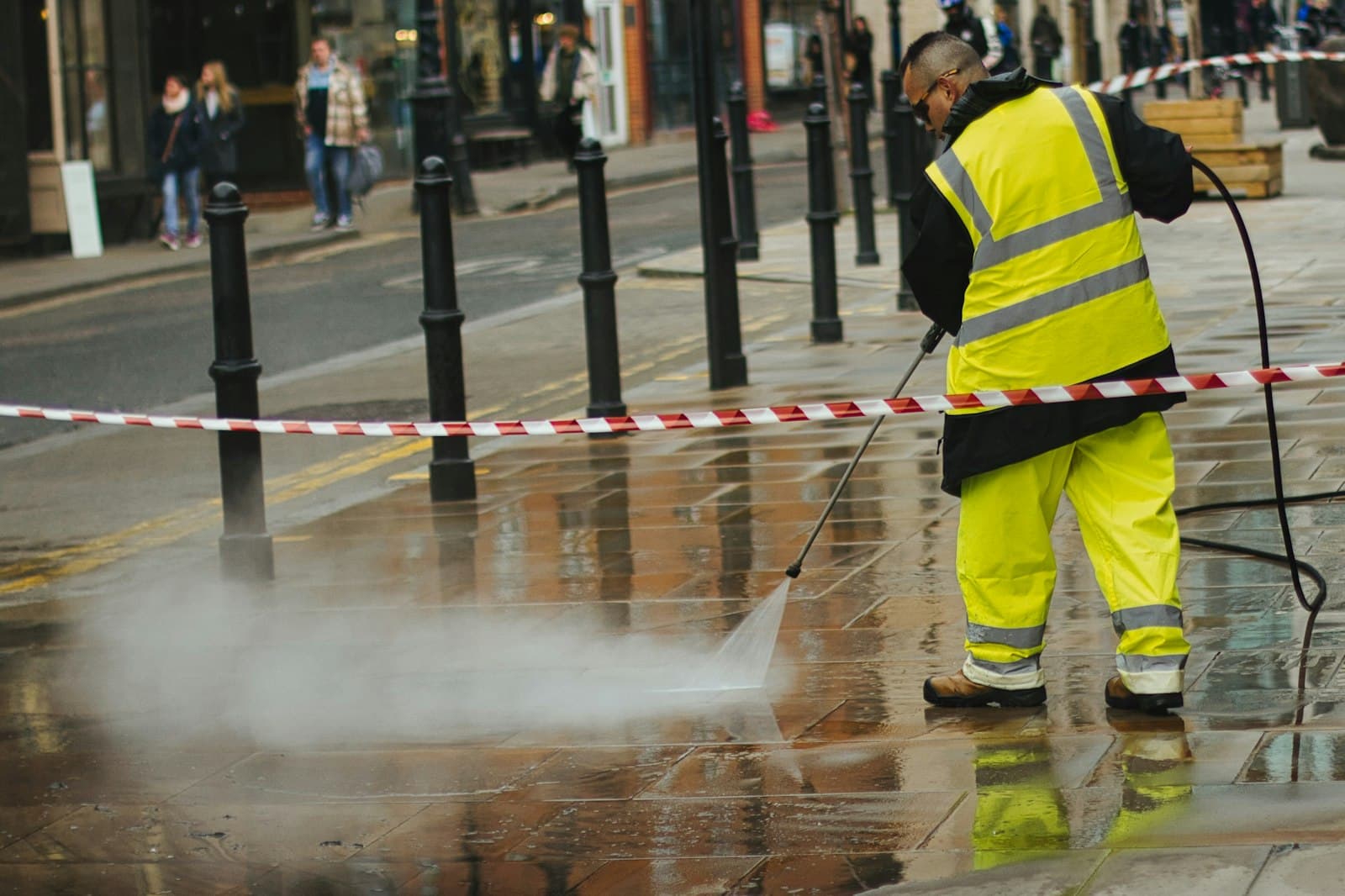
Paving does not go dark in a single season, and moss does not appear in the joints overnight. Street dust, pollen, crushed leaves and tyre rubber settle into the joint sand over time, and out of that mixture the top centimetre of the joint turns into a thin layer of growing medium. Once there is growing medium and moisture, moss, algae and weeds arrive from seed blown in by the wind.
The question we get most often is not whether to clean the paving but whether to do it yourself. On a terrace or a footpath a hired machine is a sensible choice and we will not pretend otherwise. On a driveway or a courtyard something other than the pressure rating decides the outcome: water flow, the type of attachment and, above all, what is done to the area after washing. That last point is where DIY cleaning most often falls apart.
What's included
- A rotary surface cleaner instead of a narrow jet, so a surface without streaks
- Removal of moss, algae and weeds from the joints and from the pores of the paving
- Topping up and compacting the joint sand so the paving does not shift
- Sealing that reduces absorbency and makes future cleaning easier
- Treatment of grease stains, white efflorescence and old deposits
- Terraces, stone surfaces and solar panels handled in a single visit
What actually grows in the joints of block paving
Moss and algae do not need soil, only moisture, shade and a thin layer of organic deposit. That is why they show up first on the north side of the house, under trees, next to a downpipe and anywhere the surface dries slowly after rain. Weeds are a different case: they grow from seed that has dropped into the joint from above. They do not push up through the sub-base, as many people assume.
That is exactly why the greenery comes back. A cleaned joint is empty only briefly, then it fills with dust again and the cycle restarts. The pace is set by the orientation and shading of the area, not by the quality of the paving. An open, south-facing driveway stays clean far longer than a courtyard that spends half the day in shade.
Moss is also a useful indicator. If it keeps returning to the same spot, the cause is usually a missing fall or blocked drainage rather than a weak cleaning product. It pays to sort the water out first.
Why paving darkens even when nothing is growing on it
Concrete paving is absorbent, its surface is full of tiny pores. Street dust, exhaust soot, tyre rubber, engine grease and, in shaded spots, biofilm work their way into them, that last being a thin microbial slime that turns slippery after rain. This soiling does not sit on the surface but inside it, which is why neither sweeping nor a hose will shift it.
The difference between a swept surface and a genuinely cleaned one is surprisingly large, and it shows best when a small patch is deliberately left unwashed. That is why on larger courtyards we leave one strip untouched at the start, so it is clear how much of the colour was original paving and how much was dirt.
How to clean block paving yourself
On a smaller area it is perfectly doable, and the method is no secret. What matters is the order of the steps, because most mistakes come from starting straight in with the washing. If you want to do it yourself, keep to this sequence.
- Pull the weeds out with the root or scrape them out with a joint knife, do not blast them out with pressure.
- Sweep the area thoroughly, otherwise the pressure will drive coarse dirt into the pores of the paving.
- If you use a cleaning product, apply it to damp, cool paving and never let it dry on.
- Wash with a surface-cleaner attachment, in strips and at a constant distance, or light stripes will remain.
- Once dry, top up the joint sand, brush it into the joints and settle the area with a gentle spray of water.
What not to expect from DIY: a consumer machine usually washes the surface but does not reach the dirt in the pores, and it almost always flushes out more joint sand than the owner notices while working. On a courtyard of a few hundred square metres it is also a whole weekend's work, and that is before topping up the sand or sealing.
A block paving cleaning machine: what a hired one manages and what it does not
With paving it is not only the pressure rating that decides, but mainly the water flow. Pressure loosens the dirt, flow carries it away. A domestic machine moves somewhere around eight litres a minute, a professional one several times that, and it is this difference that determines whether puddles of dirty water sit in the joints and dry into patchy marks. Always check the exact figures in the data sheet for the machine in question.
The second difference is water heating, which domestic machines do not have. The third is a surface-cleaner head with enough working width and a skirt that keeps the water at ground level. The fourth is not about the machine at all but about method, namely that after cleaning comes topping up the joint sand, compacting it and possibly sealing.
So a machine hired from a DIY store makes sense on a terrace, on steps and on a few metres of footpath. On a driveway, in an apartment block courtyard or on a greasy surface it hits its limits, and the difference shows both in the result and in the time you spend.
DIY or a contractor: a decision table
The table below is deliberately honest. There are situations where hiring a contractor is money wasted, and situations where DIY cleaning will damage the surface. Area, the condition of the joints and what lies beneath the paving are what decide.
| Situation | Doing it yourself | When a contractor pays off |
|---|---|---|
| A terrace or path of roughly twenty square metres with light green patina | Yes, with a hired machine and a surface-cleaner head it is half a day's work. | If you have no access to water and power, or the terrace is on an upper floor. |
| A driveway, courtyard or parking area over fifty square metres | Technically yes, but it means several days of work and heavy water use. | Almost always, both for machine flow and for topping up and compacting the joints. |
| Paving that rocks underfoot or has sunken in places | No, cleaning alone makes it worse by flushing out what sand is left. | Yes, the area needs assessing and the damaged part may need relaying. |
| Old oil and grease stains from a car | Partly, with an alkaline degreaser, dwell time and patience. | If the result is to look uniform, hot water and removal of the washed-off grease are needed. |
| White efflorescence on new concrete paving | Better not, an acidic product can permanently change the shade of the paving. | Yes, or simply wait, efflorescence usually washes away on its own. |
| A terrace above a flat, on a roof, or paving on pedestals | No, there is a risk of water ingress and nowhere to take the dirty water and silt. | Yes, including checking the outlets and catching the silt before it enters the drain. |
Why a narrow jet from a pressure washer harms paving
A rotary nozzle or a narrow jet concentrates all its energy into one point. In a joint that means scouring the sand out to a depth of several centimetres, and you will not see it happening because the joint fills with water. Joint sand is not cosmetic: it transfers load from block to block and holds each one in place.
The consequence therefore shows up not immediately but a few months later. A block with no lateral support starts to rock, its edges chip and rainwater finds a route into the bedding, which then settles. The paving sinks precisely where you cleaned it most thoroughly.
The second risk is the surface itself. Concrete paving has a fine pigmented top layer that gives it both colour and smoothness. A concentrated jet held close strips it away and exposes the coarse aggregate beneath. A patch roughened this way cannot be restored, and dirt will cling to it more than before.
If you see light stripes shaped like the sweep of a hand after washing, those are not better-cleaned spots but roughened surface. Dirt will return there first.
The rotary surface cleaner and why we use it
A surface cleaner is a skirted head with rotating jets that runs across the paving at a constant distance from it. The energy is spread around a whole circle instead of a single point, so the finish is even, the joints are not scoured deep and no stripes appear. Against a hand lance the difference shows most on light-coloured paving.
- An even result with no light and dark bands left by hand movement.
- Far less joint sand washed out than with a narrow jet.
- The skirt keeps water at ground level, so we do not soil the facade, plinth, windows or a parked car.
- More area cleaned per hour, which also feeds through into the price per square metre.
Hot water and where it genuinely helps
Hot water is not a marketing extra, it changes how the soiling behaves. At temperatures of the order of seventy degrees and above, grease and oil soften and can be flushed away, whereas cold water merely smears them around. On biofilm and moss, hot water shortens the dwell time enough that less chemistry, or none at all, is needed.
We bring it out where it earns its keep: driveways and parking bays with grease stains, areas around bin stores and food premises, chewing gum on footpaths and steps. On a normally soiled terrace it is unnecessary and there is no sense paying for it.
Block paving cleaner: which chemistry for what
Products for paving fall into roughly two groups and it is worth knowing which one you are buying. Alkaline cleaners break down organic matter and grease, that is moss, algae, biofilm and oil. Acidic products deal with mineral deposits, that is white efflorescence, limescale and cement residue left from laying. Using an acidic product on moss is time and money wasted.
Caution applies in the other direction just as much. Acid attacks the cement binder in concrete paving, so an undiluted or long-dwelling acidic cleaner can permanently lighten and roughen the surface. Chlorine bleach decolourises green growth, which looks like success at first glance, but it does not remove the organic layer and it damages lawn and plants wherever the water runs off.
Whatever you are applying, put it on a damp, cool surface and never let it dry. Dried-on chemistry leaves tidemarks that are harder to remove than the original dirt.
Weeds in the joints: why we do not recommend salt, vinegar or a flame
Salt and vinegar will both scorch weeds reliably, but each attacks the cement binder in concrete paving, and salt additionally stays in the sub-base and the surrounding soil. A surface treated with salt for several seasons begins to dust over, and even the plants that are meant to grow nearby give up.
A flame weeder is quick and safer on concrete, but it only burns the part above ground. The root stays in the joint and the plant regrows within weeks. The lasting answer is to remove the root mechanically and, above all, to keep the joint well compacted so seed has nowhere to lodge. That is why topping up the sand after cleaning prevents more than any spray.
Topping up the joint sand, the step that must not be skipped
Block paving holds its shape because the individual blocks brace one another through filled joints. The sand in the joint is therefore a structural part of the surface. If it is not replaced after cleaning, the blocks lose their lateral support, the surface starts to move under a car's wheels and the bedding is eventually washed out.
The method is simple but cannot be rushed. The surface must be dry or the sand sticks to the blocks. It is spread, brushed into the joints, then the joints are settled with a gentle spray of water, and once dry the sand is topped up a second time, because the first pass always drops. On larger areas the paving is finally vibrated with a plate and a slip pad so the sand compacts through the full depth of the joint.
If a contractor does not top up the joint sand after cleaning, they save an hour of labour and some material, but in a few months you will be dealing with rocking blocks and sunken patches. Ask about it before ordering, it belongs in the quote.
Silica sand and polymeric joint sand
Not every joint wants the same material. Joint width, the load on the surface and whether a car drives over it are what decide. The overview below shows what suits where and what to expect from each material.
| Material | Where it fits | What to watch for |
|---|---|---|
| Dried silica sand | Ordinary joints on terraces, footpaths and family-house driveways. | Rain gradually washes it out and it needs occasional topping up. It does not stop seeds germinating. |
| Polymeric stabilising sand | Sloping areas, surroundings of drainage channels and places where the joint must not wash out. | It is applied strictly to completely dry paving. Any residue left on the surface hardens after watering and leaves marks. |
| Fine grit or a coarser fraction | Wide joints, paving with spacer nibs and areas carrying heavier loads. | It will not reach the bottom of a narrow joint and looks visually out of place on fine paving. |
| Jointing mortar | Paving laid on a concrete bed, steps, plinths and areas where the joint must not move. | It does not belong on a sand bed. The surface loses its flexibility, the mortar cracks and water gets beneath the paving. |
Sealing block paving: what it actually does
A sealer is not a varnish and does not form a film on the paving that could peel off. It is a product that soaks into the pores of the concrete and reduces their absorbency. Water, oil and coloured liquids then penetrate more slowly and stay on the surface longer, where they can be wiped up before they work their way deeper.
What you really get: fewer soaked-in stains, a slower return of greenery because the pores clog less quickly, and above all much easier future cleaning, since most deposits then rinse off with ordinary water. What you do not get: the paving will be no more resistant to mechanical damage, and moss will not disappear, it simply arrives more slowly.
- A colourless matt sealer keeps the original look and shade of the paving.
- A wet-look sealer darkens and deepens the shade, and that cannot be undone.
- It is applied strictly to clean, completely dry paving, otherwise it traps moisture beneath the surface.
- The effect fades over time and reapplication is usually due after a few years.
When sealing makes sense and when it is pointless
It always makes sense straight after a thorough clean, because a sealer locks in a clean surface, not dirt. Beyond that it pays on driveways and parking bays where oil drips are likely, on terraces beside a barbecue or dining table where fat, wine and coffee land, and on areas under trees that drop resin and berry pigment.
It is pointless on permanently shaded, wet spots that never dry out, because moss will grow on the surface there regardless of absorbency. Nor does it make sense on an area due to be relaid soon, or on paving with a roughened, damaged surface, where it would only accentuate the differences. On newly laid paving you wait until the efflorescence has finished washing out.
Oil and grease stains from a car
Oil soaks into concrete paving, and the longer it sits the deeper it goes. So do not wash a fresh stain with water, that only spreads it over a larger area. Cover it with an absorbent such as dry sand or cat litter, leave it for a few hours to draw the oil out, sweep it up and only then clean.
An older stain is tackled with an alkaline degreaser, enough dwell time and hot water, usually over several repetitions. Let us be honest: on a years-old stain on light paving you can achieve a marked lightening, not always complete removal. If it is only one or two blocks, the cleanest answer is often to lift the block and turn it over, or swap it for a spare.
White efflorescence on concrete paving and where it comes from
The white bloom on new paving is neither a manufacturing fault nor cement residue from laying, although it looks like it. It forms when water carries dissolved calcium from inside the concrete to the surface, where it reacts with carbon dioxide in the air to form a whitish carbonate film. It appears mainly in the first period after laying, in cold, damp weather, and usually unevenly, which is what makes it look so obtrusive.
In most cases efflorescence washes away by itself over one or two seasons and there is no need to touch it. If it bothers you, it is removed with an acidic product made specifically for efflorescence, with a short dwell time and thorough rinsing, because the acid also attacks the cement binder of the paving itself. We always test first on a patch that is out of sight.
When paving should not be cleaned
The timing decides the outcome more than people expect. Cleaning in the wrong weather either does not work or damages the surface, and the money spent is wasted. These are the situations in which we would rather move the job to another date.
- In frost and below roughly five degrees. Water freezes in the joints and pores, the chemistry does not work and the surface is slippery.
- In the first weeks after laying. The bedding is still settling and the joints are not compacted, so pressurised water flushes them out.
- In direct sun on a hot surface. The product dries before it can act and leaves tidemarks.
- Just before rain if sand is to be topped up or a sealer applied. Both need a dry surface and time.
- In wind when sealing or spraying chemistry. The drifting aerosol ends up on the car, the facade and the flowerbed.
The best window for a full clean with sand topping-up and sealing runs from spring to autumn, ideally when the surface has one or two dry days ahead of it after washing. Spring slots fill early, we book them from late winter onwards.
How often it is worth repeating
At an ordinary family house a full machine clean is worth doing every two to four years. The surface itself, though, tells you more accurately than the calendar. If the paving is slippery after rain, if a continuous green film appears in the joints, or if water lingers between the blocks, the time has come regardless of when it was last cleaned.
Sealing, good falls, a sunny open position and regular autumn sweeping all lengthen the interval. Shade, nearby trees and conifers, leaves left to overwinter on the surface and the area around bin stores all shorten it. Between major cleans it is enough to pull the weeds and sweep the joints once a season, a couple of hours' work that pushes the next machine clean back by a year.
Terrace cleaning: concrete, stone and timber are cleaned differently
Terrace cleaning follows different rules from driveway cleaning, because terraces tend to be built of softer, more absorbent materials and people walk on them barefoot. The same pressure that does a driveway no harm can ruin sandstone paving or a timber board in seconds. So we first ask what the terrace is made of and only then choose the method.
- Concrete paving and frost-resistant ceramic take a surface cleaner and higher pressure, only the joints and movement gaps need protecting.
- Natural stone varies by type. Granite is durable, while sandstone and travertine are soft and absorbent, roughen quickly and are cleaned at lower pressure with gentler chemistry.
- Timber and composite decking take only low pressure and are cleaned along the grain, otherwise the fibres tear and the board starts to splinter.
- Roof terraces, terraces above living space and paving on pedestals need their outlets checked and the silt caught, otherwise the drain blocks.
On pedestal paving and terraces above living space we never flush silt into the outlet. It settles in the drain and the blockage only shows in the first heavy rain, which is the worst possible moment to deal with it.
Drainage, gullies and channels are part of the job
Water from paving must have somewhere to go, otherwise everything else is done in vain. If a puddle stands on the surface after rain, the cause is usually settled bedding, a missing fall, or a blocked channel drain or gully. Cleaning makes such an area look better briefly, but moss returns first exactly where the water stands.
So while cleaning we open and flush the channel drains and gullies in the surface, and we flag it if we find a sunken area or a fall running towards the house instead of away from it. If the water is coming from an overflowing or blocked gutter, it is worth fixing that first. Otherwise the same patch of paving will keep going green no matter how thoroughly it was washed.
Cleaning solar and photovoltaic panels
We clean panels for much the same reason as paving, it is just more visible on the electricity bill. A layer of dust, pollen, pine needles and above all bird droppings lets less light through and cuts output, substantially so where the soiling is continuous or droppings cast shade. Droppings are also acidic and, over time, damage the frame and the perimeter seal of the panel.
We never wash panels with high pressure or an abrasive pad, as a scratched or damaged glass top layer means a permanent loss of output. We use a soft brush on a telescopic pole and demineralised water, which leaves no limescale as it dries, so the panel does not need wiping dry. We work in the morning or evening, and cold water must never be poured onto a hot panel because of the risk of thermal shock.
Since the panels are on the roof, we usually do them during the same visit as roof and gutter cleaning, so access at height is not paid for twice. While we are there we also check the space beneath the panels, where pigeons like to nest, and the outlets that the run-off water reaches.
What drives the price of paving cleaning
The price comes from the size of the area, the degree of soiling and the amount of work after the washing itself. Two courtyards of identical size can differ by a factor of two if one sits under trees and has gone years without cleaning while the other is maintained every autumn. That is why, during a survey, we look mainly at the condition of the joints rather than just the colour of the paving.
- Area and how broken up it is, plenty of edges, steps and flowerbeds slow the work down.
- Degree of soiling, thick moss and rooted weeds mean extra work before washing.
- Access to water and power, or the need to bring water in our own tank.
- Whether joint sand is topped up, in what quantity and of what type.
- Whether the surface is sealed at the end and with what type of sealer.
- Catching and removing the washed-off silt, especially on terraces and in courtyards with no drain.
In an apartment block, a courtyard or footpaths are common parts, so the owners' association or the building manager decides on the job. We prepare the quote in a form the manager can put to a meeting or a written vote.
Where in Bratislava we clean paving and terraces
We work across Bratislava including Petržalka, Ružinov, Nové Mesto, Staré Mesto, Karlova Ves, Dúbravka, Rača, Vrakuňa and Podunajské Biskupice, and by arrangement also in Senec, Pezinok, Malacky and Stupava. Most jobs are driveways and courtyards at family houses in the outer districts, terraces on new apartment buildings, and paved areas on company premises, where paving cleaning is combined with washing the facade or maintaining the roof.
How it works
Survey and preparation
From photos or on site we establish the area, the condition of the joints and the type of soiling, then remove the weeds and sweep the surface thoroughly.
Machine cleaning
We work across the area in strips with a surface cleaner, bring in hot water or a suitable product for grease and biofilm, and take the washed-off silt away.
Joints and sealing
Once dry we top up and compact the joint sand, seal the surface on request and check the gullies and channel drains.
💡 The price depends on the area, the degree of soiling, whether joint sand is topped up and whether the surface is sealed at the end. Send photos and a rough area and we usually quote within 24 hours.
Frequently asked questions
How much does cleaning block paving cost?
The price is set by the area, the degree of soiling and whether joint sand is topped up and the surface sealed. Those finishing steps are what most differentiates two courtyards of the same size. Send photos and a rough area and we usually have a quote within 24 hours.
Will high pressure damage the paving or the joints?
With the wrong method yes, which is why we work with a rotary surface cleaner rather than a narrow jet. A narrow jet held close scours joint sand out to depth and, on concrete paving, strips off the fine pigmented layer, which cannot be restored. A surface cleaner spreads the energy around a circle and holds a constant distance from the surface.
Does the joint sand have to be topped up after cleaning?
Yes, and it is the most important step after the washing itself. Sand in the joint braces the blocks against each other, and without it the surface starts to move, blocks rock, edges chip and the bedding washes out. The sand goes onto a dry surface, is brushed into the joints, settled with water and topped up a second time once dry.
How long does paving stay clean after cleaning?
At an ordinary family house the next machine clean is due in two to four years. Position matters most: an open, sunny surface lasts far longer than a shaded courtyard or one under trees. Sealing and regular autumn sweeping, so that leaves do not overwinter on the surface, both lengthen the interval.
Is sealing block paving worth it?
It is worth it anywhere soaked-in stains are likely, that is driveways, parking bays and terraces beside a barbecue. A sealer is not a varnish: it soaks into the pores and reduces absorbency, so stains do not have time to penetrate and future cleaning is much easier. It will not prevent moss or mechanical damage, it only slows the return of dirt.
Can paving be cleaned in winter or right after laying?
We recommend neither. Below roughly five degrees water freezes in the joints, the chemistry does not work and the surface is slippery, so the result is poor and the risk high. Newly laid paving needs time for the bedding to settle and the joints to compact, otherwise pressurised water flushes them out. The best time is spring to autumn, when the surface has dry days ahead of it after washing.
When can you walk and drive on cleaned paving?
You can walk on it as soon as we finish, and drive on it once the joints are compacted, usually the same day. If the surface is being sealed it first has to dry completely and then the sealer needs to cure, so we recommend keeping a driveway free until the following day. The exact timing depends on the weather and we will tell you on site.
Can you remove old oil stains from a car?
In most cases we lighten them markedly; complete removal of a years-old stain on light paving is not something we can promise. Oil soaks into the pores of the concrete and the longer it sits the deeper it goes. We use an alkaline degreaser, dwell time and hot water, usually over several repetitions. Where only one or two blocks are affected, turning the block over or replacing it is often the cleanest answer.
Will you also wash the solar panels during the same visit?
Yes, and it makes sense because roof access is then not paid for twice. We clean panels with a soft brush and demineralised water, never with high pressure or anything abrasive, and we work in the morning or evening so that cold water does not hit hot glass. While we are there we also check the space beneath the panels and the roof outlets.
Related services
Need cleaning or work at height?
Get in touch and we'll prepare a tailored, no-obligation quote, usually within 24 hours.