
Services
Facade cleaning that won't damage the render
Facade cleaning is the removal of dust, exhaust deposits, algae, moss and grime from a building's exterior. We use a gentle method, that is water at controlled pressure and, where needed, suitable chemistry, so the original look is restored without damaging render or cladding.
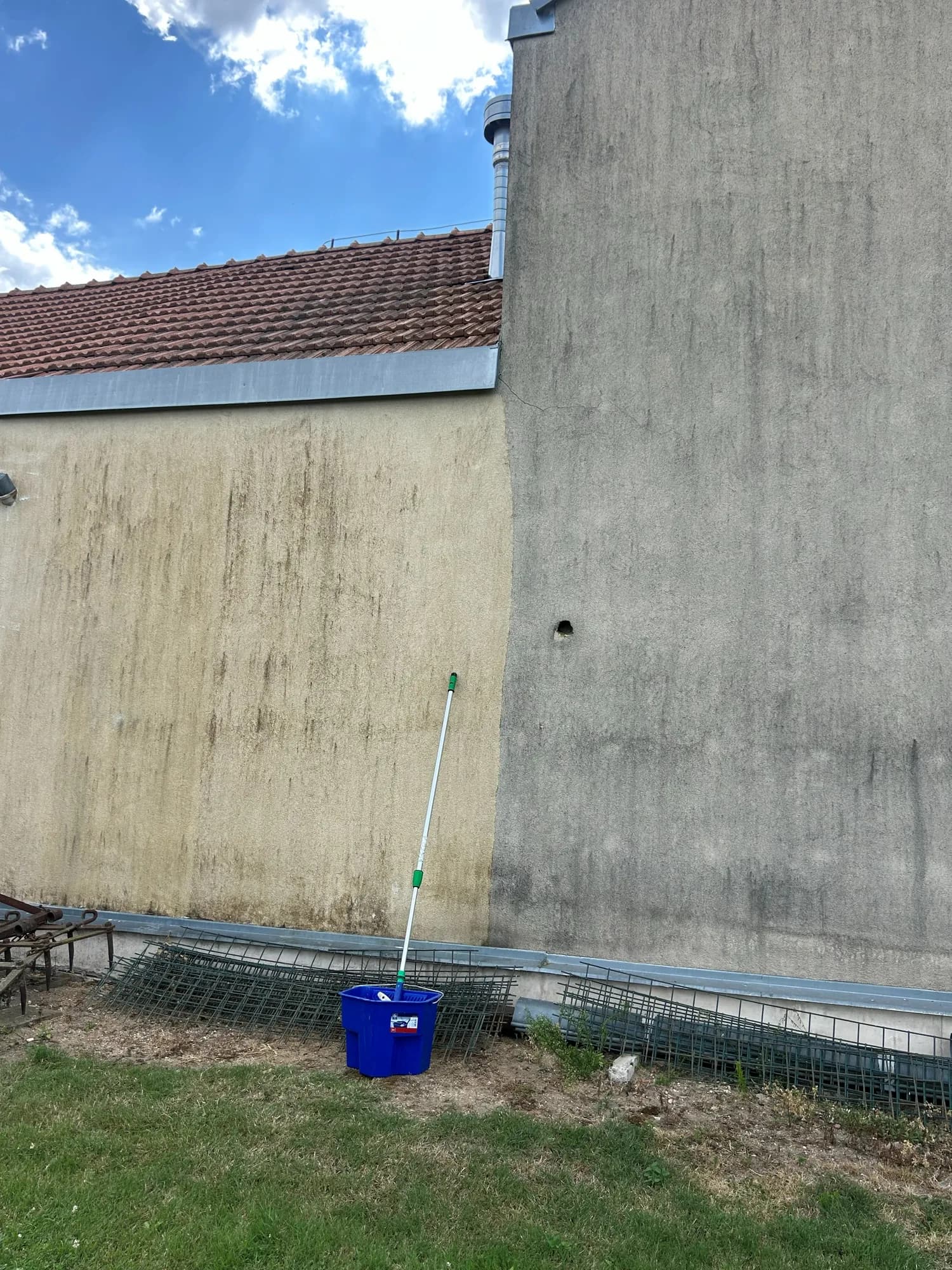
A dirty facade is not only an aesthetic issue. Algae and moss hold moisture, that moisture keeps the surface permanently damp and gradually attacks the render and the insulation system beneath it. Regular cleaning extends the life of the facade and pushes back the date when repainting becomes unavoidable.
We clean the facades of apartment blocks, office buildings, commercial premises and family houses. We choose the method and the pressure to match the surface, so a thin render on external insulation is treated differently from pebble-dash, ceramic tiling, stone, timber, composite panels or glass.
What's included
- Removal of algae, moss, lichen, dust and exhaust deposits
- Gentle, controlled pressure chosen to suit the type and condition of the surface
- Optional biocidal treatment that slows the regrowth of algae
- Access by rope technique or platform, so no scaffolding
- Protection of windows, doors, electrics and planting below the work area
- A facade prepared for painting or repair, should it turn out to need one
- A longer life for the facade and for the insulation system beneath it
Why a facade turns green, black and grey
The green or black coating on a facade is not dirt stuck on from the street. It is a living organism. Most often it is single-celled green algae, which form a continuous greenish to grey-green film on a damp surface, then mosses wherever water lingers, and lichens, which grow slowly but sink attachment structures into the surface and form pale or dark circular patches.
On top of that sits a second, genuinely inert layer: street dust, exhaust deposits and soot from chimneys and traffic. These cling worst on the north and street-facing sides, on sills and under ledges where rain does not wash them off. That is why a facade beside a road tends to be grey while one facing a garden turns green: two different kinds of soiling.
The distinction matters, because each type is removed differently. Dust and soot wash off with water, whereas algae and lichen must first be killed chemically, otherwise you merely wipe them off the surface while the root layer stays in the pores of the render and grows back within a year.
Why the north and shaded sides get overgrown fastest
Algae need water and tolerate low light. On a south wall the sun dries the surface within tens of minutes after rain, on a north wall it stays damp for hours, and in winter for days. That difference in the length of time the surface stays wet is the single variable that decides whether algae take hold.
So on the same house you see a green north wall and a clean south one. Shade from a tree, a fence or the neighbouring building works the same way, as does the proximity of a lawn or hedge, from which spores spread and moisture is reflected back. A family house with conifers planted a metre from the wall almost always has an overgrown facade.
Where possible, cut back shrubs and trees before cleaning so the wall can dry after rain. It is the cheapest measure against regrowth, and without it any treatment lasts less time.
Why an insulated facade gets overgrown faster than a solid wall
This is one of the paradoxes of external insulation, and it reliably surprises homeowners. A solid wall without insulation has a large thermal mass. It warms through during the day, radiates that heat at night and its surface stays warmer than the surrounding air, so water does not condense on it.
An external thermal insulation composite system, ETICS, behaves in exactly the opposite way. The insulation separates the thin outer render from the heat of the building. That render is a few millimetres thick and has nowhere to draw heat from, so at night it cools quickly and deeply. It is on this cold surface that moisture sits in the morning, and that is why insulated houses from the nineties and new builds alike turn green sooner than the old brick houses next door.
The dew point, or why thin render is wet in the morning
The dew point is the temperature at which air can no longer hold its water vapour and that vapour condenses into droplets. If a surface is colder than the dew point of the surrounding air, dew forms on it. It is the same effect as the misted-up car window in the morning or a cold glass taken out of the fridge.
On a clear night a facade radiates heat to the sky and its surface drops below air temperature, on thin render over insulation by several degrees. Such a wall gets covered in dew and, until the sun reaches it in the morning, it stays wet. On the north side this repeats all year round, which is an ideal regime for algae: fresh water every day without any rain at all.
One practical conclusion follows. A greening facade does not mean something was built badly or that water is getting into the wall. In most cases it is a normal consequence of the physics of an insulated envelope, and the answer is cleaning and biocidal treatment, not rebuilding.
How much pressure each facade can take
The number on the machine tells you almost nothing. What actually lands on the render is a combination of three things: pressure, nozzle type and distance. A machine at one hundred and fifty bar with a wide fan nozzle held forty centimetres away is far gentler on the surface than half that pressure with a pencil jet held five centimetres away. That is why an experienced operator controls the standoff and the angle above all, not the valve.
The second thing a layperson does not know: thin render carries its colour pigment and binder only in the surface layer. Once high pressure strips that away, what lies beneath is paler, duller and far more absorbent. The facade looks clean for a few months, but it is in fact damaged, it draws in water and it becomes overgrown sooner than before.
| Surface | How it is cleaned | What excessive pressure risks |
|---|---|---|
| Thin silicone or silicate render on external insulation | Low pressure, a wide fan nozzle, a generous standoff; the chemistry and its dwell time do the real work. | Loss of the coloured layer, exposed aggregate and nozzle striping that never comes out. |
| Pebble-dash and older scraped render | Medium pressure, a test patch first; loose aggregate is treated rather than blasted. | Aggregate is washed out and whole areas later fall off, especially at corners and under sills. |
| Concrete and fair-faced concrete | Tolerates higher pressure, though on fair-faced concrete evenness matters so no lighter marks are left. | Patchy results, and exposed reinforcement where the cover layer is already thin. |
| Ceramic tiling and grout | The tile takes more, the joint far less. The jet is worked across the tile face, not into the joint. | Eroded grout, a path for water behind the tiles and, in winter, frost pushing tiles off. |
| Natural stone and facing brick | Soft stone and old brick only at low pressure with gentle chemistry and no strong acids. | Damage to soft mortar joints and opened stone pores, after which it soils faster. |
| Timber cladding | Low pressure along the grain, and once dry the coating or oil is normally renewed. | Fibres raised into a furry surface, soft growth rings torn out and saturated timber that later cracks. |
| Composite and sheet-metal cladding, glass and aluminium frames | Low pressure or hand washing with the water squeegeed off, so no dried droplet marks are left. | Water forced behind trims and joints, damaged seals and a spoilt factory finish on the metal. |
The first pass is always on a test patch, usually somewhere less visible such as a rear wall or under a balcony. Only once we see how the surface behaves do we set the pressure and chemistry for the whole house.
Mechanical cleaning or chemistry? The difference is fundamental
Mechanical cleaning removes soiling by the force of water. It is quick, it works on dust, soot and hard deposits, and it leaves nothing behind on the surface. The drawback is that it only removes algae and lichen from the surface. The cells that survive in the pores and micro-cracks multiply within a season and the green tinge returns.
Chemical cleaning works the other way round. The product is applied, left to dwell and kills the organism at depth, so the surface can then be washed at far lower pressure. On insulated systems and delicate renders this is practically the only safe route, and what matters is the dwell time, not force.
In practice the two are combined. On one house the street side is grimy with dust while the rear is overgrown with algae, and those are two entirely different operations within the same job.
| Method | How it works | Where it fits |
|---|---|---|
| Low-pressure washing | Water rinses off dust and loose deposits without loading the surface. | New or lightly soiled facades, routine upkeep, glass and composite panels. |
| High-pressure cleaning | The force of the jet removes the soiling and the result is immediate. | Concrete, ceramics, stone plinths and other hard, resilient surfaces. |
| Chemical cleaning with active foam | The foam keeps the product on a vertical face long enough to work even on a smooth wall. | Greasy deposits, traffic soot and heavy algal or lichen growth. |
| Biocidal treatment left without rinsing | Applied to a clean facade, it stays in the surface as a brake on regrowth. | North and shaded walls, houses next to trees, the finish to most jobs. |
| Hot water and steam | Heat dissolves grease and organic matter so less pressure is needed. | Graffiti, chewing gum, greasy plinths and areas near premises and garages. |
What pressure-washing a facade means and why people search for it
In Slovak, pressure-washing a facade goes by a colloquial term derived from the nickname for a pressure washer, and most people mean by it exactly what we call high-pressure cleaning. It is the same operation, simply named the way people actually talk about it.
One confusion is worth clearing up. Some people spell the Slovak term with a long vowel, which makes it look as though it came from the word for lime. It has nothing to do with limewash, though; it really is just washing with pressurised water. If you need the colour restored, what you are looking for is repainting, not cleaning.
Here too, pressure washing on its own is not always the right answer. On an insulated house we use it only as a supplement to chemistry and at a markedly reduced pressure; otherwise the facade would look better for a few months and worse for the next ten years.
Biocidal treatment against algae and how long it lasts
Biocidal treatment means applying a product that kills algae, moss and lichen down inside the pores of the render and, for a time, prevents new growth from taking hold. It goes on a washed and dry facade, usually sprayed and left without rinsing, so the active substance stays in the surface layer.
How long it lasts depends far less on the product than on how quickly your wall dries out. On a sunlit, ventilated wall the treatment holds for considerably longer than on a north wall under trees where the surface is wet every morning. We are talking about a matter of seasons rather than a permanent state, and nobody can honestly give you an exact figure in advance.
A useful detail: after treatment the facade sometimes does not come fully clean straight away. Dead algae keep washing off in the rain for several weeks, so the result you see on the day we leave is not yet the final one.
How cleaning differs from surface to surface
A facade is almost always a mix of materials. On one house you will find thin render, a plinth cladding, metal sills, timber soffits and glazed balustrades, and each behaves differently. That is why both the technical and the commercial thinking is done area by area, not for the house as a whole.
- Silicone render repels water and cleans well, but its surface is sensitive to pressure and abrasion.
- Silicate render is more open and more absorbent, and algae grip it harder, so the chemistry needs a longer dwell time.
- Pebble-dash has a coarse aggregate that traps dirt but also washes out easily under high pressure and starts to fall away.
- Ceramic tiling takes almost anything; the weak point is the grout, through which water gets behind the tiles.
- Natural stone is cleaned without strong acids, which dissolve calcareous stone and leave dull patches.
- Timber is cleaned at low pressure along the grain and the coating is usually renewed once dry, otherwise it greys again.
- Composite and metal cassette panels are washed by hand or at low pressure so water is not forced behind the joints.
- Glass and frames are finished so no dried droplets remain, which is more a window-cleaning technique than a facade one.
The risk of water getting into the insulation and how we prevent it
This is the most real risk in the whole job and the one that most often causes damage during DIY washing. An insulation system is protected on the outside by nothing more than a thin render and adhesive with a reinforcing mesh. It is not the flat areas that are critical but the details: window reveals, the junction with the sill, parapet flashings, corners at doors, and penetrations for air conditioning and cables.
If a jet is aimed at those points perpendicularly and from close range, water passes behind the render into the insulation. From there it has no quick way out. It shows up months later as a dark patch that keeps returning, or as render blown off after the first frost.
- We work at an angle from the top down, never perpendicular and never upwards into a joint.
- At reveals, sills and flashings we reduce the pressure and increase the standoff.
- Damaged or missing sealant around windows is spotted beforehand and flagged to you before work starts.
- Areas of blown or hollow render are worked round at low pressure and not forced clean.
If you tap the facade and it sounds hollow somewhere, the render has parted from the insulation there. Such an area must not be pressure cleaned; it needs repairing first. We handle that as part of facade repairs.
Protecting windows, doors, electrics and planting
On a well-run job the preparation takes as long as the washing itself, and it is precisely the preparation that separates professional cleaning from a hired pressure washer. We cover sockets, doorbells, cameras, light fittings, distribution boxes and ventilation grilles, because water reaches those most easily and the damage costs far more than the whole clean.
We do not cover plants beneath the wall with plastic sheeting, which would scorch them in the sun. The method that works is the opposite: soak them thoroughly with water before the chemistry goes on, so leaves and soil are already saturated and the product cannot be absorbed, then rinse them again once the work is done. The same goes for lawn next to the wall.
- Windows and doors closed, and neighbours told in advance.
- Cars moved out of reach of spray and falling debris.
- External blinds and insect screens raised or covered.
- Terrace furniture, barbecue and drying racks removed or sheeted.
- The area beneath the work cordoned off so nobody walks underneath.
Where the water from the facade goes
Washing the facade of a family house sends hundreds of litres of water down the wall, carrying dead algae, dust and residues of the product. Where it will flow should be agreed before the start, not once it is already happening. In practice it is best if the water runs across a paved area into the surface-water drain or soaks away over a large enough stretch of lawn.
What we avoid: a well and its surroundings, a pond with wildlife, a freshly planted bed, an open cellar light well and a soakaway box right against the wall. If any of these are by the house, tell us beforehand; the solution is simple but it has to be planned.
A practical note for apartment blocks: it pays to check roof outlets and gutters before cleaning. Debris washed off the facade can top them up enough that the first heavy rain afterwards ends in an overflow.
Rust marks, efflorescence and stains that washing alone will not shift
A rust mark under a railing, a bracket or an anchor is not dirt lying on the surface. Iron oxides penetrate the pores of the render and are removed with a targeted rust treatment, not with pressure. Crucially, until the source is dealt with, that is the corroding component, the stain returns after the first rains. Cleaning without repairing the fixing is wasted work here.
Efflorescence is the white salt bloom brought to the surface by water passing through the masonry. It does not wash off. On the contrary, washing dissolves it and it recrystallises as it dries, often more visibly than before. The correct approach is to remove it dry first and only then wash. If it keeps returning, the problem is not on the surface but in moisture reaching the wall from somewhere.
- Graffiti: tackled with a remover matched to the paint type and the absorbency of the render, not with pressure.
- Streaks below a sill: they point to a missing drip groove or poor flashing.
- Dark patches above the plinth: usually splash-back, better fixed by adjusting the ground than by more cleaning.
- Soot above windows: usually fire residue, which needs its own procedure and often repainting as well.
How often a facade should be cleaned
There is no single interval that fits every house, because position and orientation decide it, not the age of the facade. A street frontage in the centre gets grimy from traffic, and you notice it when the shade of the colour changes. A shaded wall facing a garden does not get grimy but overgrown, and there the signal is a green tinge on the north side.
A sensible rule of thumb is to clean every few years, at shorter intervals on shaded and insulated houses and longer ones on sunny, ventilated walls. More practical than counting years is watching two things: whether the shade of the facade is changing and whether a green film is appearing on the north side.
Putting it off does not pay. An overgrown facade needs longer treatment and more chemistry, and it still has to be washed gently. The effort grows while the options do not.
What to do about cracks that appear during cleaning
A washed facade reveals what the dirt has been hiding for years. Most often that means hairline cracks in the render, cracks running out from window corners, detached areas that sound hollow when tapped, and missing or perished sealant around windows and at flashings.
There is no need to panic, but no need to ignore it either. Hairline cracks are usually confined to the surface layer and a crack-bridging coating deals with them. A crack you can slide a knife tip into, or a hollow-sounding area, means water is getting behind the render, and that is a repair rather than cosmetics.
So after washing we go over the facade once more and show what we find in photographs. If it makes sense to deal with it in one go, we can carry out the repair as part of facade repairs while access is still set up. Setting access up twice always costs more than once.
Cleaning a family house and an apartment block, and how they differ
On a family house the main themes are gentleness and the surroundings. The facade is usually insulated and finished in thin render, and around the house there is a garden, a terrace, equipment and planting. Access can be handled from a ladder and a platform, the height rarely exceeds two storeys, and cleaning the facade of a house is typically a one to two day matter.
On an apartment block other things dominate: height, activity below the work area, and organisation. Here it is rope access, cordoning off the ground beneath us, notifying residents to keep their windows closed, and agreeing with the manager when work may take place. The job runs from days to weeks and is handled section by section, not the whole building at once.
The decision-making differs too. On a family house the owner decides; in an apartment block the owners do, through the manager or the association, and it is usually funded from the repair fund. We prepare the documents in a form the manager can put before a meeting.
When cleaning is no longer enough and painting is needed
Cleaning removes what sits on the facade or grows in it. It cannot bring back colour taken by the sun, and it cannot replace the binder that has leached out of the render over the years. There is a simple test you can do yourself: wipe a dry part of the facade with a dark cloth or your palm. If it comes away with noticeable coloured dust, the render is chalking and cleaning will only expose it further.
Other signals that repainting is worth considering straight away: the colour has faded unevenly and washing will show that up even more, there are patched areas in a different shade, there are hairline cracks, or the growth is so heavy that it will return even after treatment. In these cases cleaning is not pointless, quite the opposite: it is the first and necessary step before painting. Paint will not hold on an unwashed, overgrown facade.
If you already know the facade is due for repainting, tell us at the outset. Preparation for painting is done slightly differently from a routine wash, and the sequence can be planned so that access is only set up once.
Season and temperature: when a facade is cleaned
The main season runs from spring to autumn, and the reason is simple: the work uses water. At temperatures around freezing, water on the facade turns to ice, expands inside the pores and widens micro-cracks, which is exactly what we want to avoid. So facades are not washed in frost, and no biocidal treatment is done either.
There is a second unsuitable condition that few people ask about: strong sun on a baking wall. Chemistry on a hot facade dries before it can act and can leave tide marks. So in summer we work sunlit walls early in the morning or towards evening, or else follow the shade round the building.
A practical point about scheduling: spring is the busiest period and capacity fills up fastest. If you are not tied to a particular month, autumn tends to be quieter and is often better for the cleaning itself, because the walls are not overheated.
What drives the price of facade cleaning
The price of facade cleaning is not a flat rate per house; it comes from how much area is cleaned, how it can be reached and what has to come off it. Two facades of the same size can work out very differently if one is merely dusty and the other is covered in lichen on its north side.
- Area in square metres and the complexity of the facade, that is the number of windows, balconies, ledges and details.
- Height and the access method, that is whether a platform will do or rope access is required.
- Surface type, since a delicate render means slower work and more chemistry in place of pressure.
- The extent and type of soiling, with lichen and greasy deposits always more laborious than dust.
- The amount of preparation and protection needed, that is sheeting, cordoning off and the water supply.
- Additional work such as biocidal treatment, graffiti removal or finishing the windows.
We quote only once we have photographs or have carried out a survey. A figure given over the phone without anyone having seen your wall is a guess that will change on site anyway, and that helps nobody.
Rope, platform or scaffolding
On work at height, access is often a bigger item than the work itself, so it pays to know what suits when. A platform is quickest where there is hard standing, room to set up and no problem with the distance from the wall. It does not suit narrow courtyards, a lawn after rain, or buildings with overhanging structures.
Rope access solves exactly what a platform cannot. From above we reach any point on the facade regardless of what is beneath it, we take up no parking or pavement, and we do not need a week to erect and dismantle anything. On tall, complex buildings it is usually cheaper as well.
Scaffolding makes sense when the cleaning is followed by further work across the whole surface, typically repainting or a major repair. Erecting it just to wash a facade almost never pays.
The commonest mistakes when washing a facade yourself
Washing your own house facade makes sense on a ground-floor wall that is merely dusty and with a machine you can throttle back. The trouble is that a hired pressure washer tempts you into exactly the opposite of what the surface needs, and the mistakes show up not immediately but a year later.
- The nozzle pressed against the wall. It leaves lighter stripes and a wavy surface that nothing but repainting will even out.
- Working from the bottom up. Dirty water runs over an as yet unwashed surface and leaves marks that are hard to clean off.
- The jet aimed straight into a window reveal or under a sill. This is the commonest cause of water getting into the insulation.
- Chlorine bleach instead of a facade product. It decolours algae on the surface but leaves them in the pores, attacks metal components and kills the planting below.
- Acid on a stone or concrete plinth. It dissolves the surface and leaves dull, permanently spoilt patches.
- A ladder leant against the facade at a height where a ladder has no place. It is the only mistake on this list that can cost you more than the facade.
How the survey works and what we need from you
For a first estimate photographs are usually enough. Photograph the house from every side at a distance, then a close-up of the most overgrown or most soiled spot. The distance shots show us the extent and the access, the close-up shows whether we are dealing with algae, lichen or deposits, and that determines both the method and the time.
On larger buildings and where access is complicated we come for a site survey. We then also run a test on a small area, so we know how the surface behaves and so you can see the result before committing to the whole building.
- Photographs of the house from every side plus a close-up of the soiling.
- The approximate height, that is the number of storeys, and whether the facade is insulated.
- The year of the last refurbishment or repaint, if you know it.
- Access to the building and whether a platform can be set up, or how the roof can be reached.
- Availability of water and electricity on site.
- What lies below the wall: a well, a pond, a flower bed, a terrace or parking.
Where in Bratislava we clean facades
We work across Bratislava including Petržalka, Ružinov, Nové Mesto, Staré Mesto, Karlova Ves, Dúbravka, Rača, Vrakuňa and Podunajské Biskupice, and by arrangement also in Senec, Pezinok, Malacky and Stupava. The mix of jobs varies noticeably from district to district.
In Petržalka and Ružinov it is mostly insulated apartment blocks, where the issue is algae on north walls and the work is done from ropes. In Staré Mesto it is older renders, stone and traffic grime, so a more cautious approach. In Karlova Ves, Dúbravka and Rača family houses below the slopes and among greenery predominate, and there the regrowth is fastest.
How it works
Surface assessment and a test patch
We identify the type of soiling and the facade material and trial the pressure and product somewhere less visible, so we know how the surface will behave.
Protecting the surroundings, washing and cleaning
We cover the electrics, soak the planting and wash the facade at controlled pressure from the top down, treating stubborn soiling with a suitable product and a proper dwell time.
Check, treatment and photographic record
We check the result, apply biocidal treatment against algae where needed and show you in photographs any areas that would merit repair.
💡 The price depends on the area and complexity of the facade, the height and access method, the surface type and the degree of soiling, so send us photos of the house plus a close-up of the soiling and we will prepare a quote.
Frequently asked questions
Will pressurised water damage the render?
No, provided the pressure, nozzle and standoff are matched to the surface. On delicate thin render over insulation we work at low pressure and let the chemistry and its dwell time do the real work. Excessive pressure from close range strips the coloured layer, exposes the aggregate, and the facade then absorbs water and gets overgrown faster than before.
How often should a facade be cleaned?
Usually every few years, and it is position and orientation that decide, not the age of the facade. Shaded, insulated and damp walls grow algae faster and need a shorter interval, while sunny, ventilated walls last longer. More practical than counting years is watching whether the shade of the facade changes and whether a green film appears on the north side.
How much does cleaning the facade of a family house cost?
The price is set by the area, the complexity of the facade, the height and access method, the surface type and the degree of soiling. Between two houses of the same size the condition of the facade is usually the biggest difference, because established lichen is far more laborious than dust. Send us photographs of the house from every side plus a close-up of the soiling and we usually have a quote within 24 hours.
Why is my facade green when the house is new and insulated?
Because thin render over insulation is decoupled from the building's heat and cools below air temperature at night, so dew forms on it in the morning. Algae need moisture rather than dirt to take hold, which is why new, clean houses turn green too. It is not a construction fault or a sign of water ingress; the answer is cleaning and biocidal treatment.
How long does a facade stay clean after treatment against algae?
A matter of seasons, though nobody can honestly promise an exact figure, because what decides it is how quickly your wall dries. On a sunlit, ventilated facade the treatment holds considerably longer than on a north side under trees where the surface is wet every morning. Cutting back shrubs and trees by the wall is the cheapest measure that extends that interval.
Will washing let water into the insulation or the windows?
Not when it is done properly. It is not the flat areas that are critical but the details, that is window reveals, sills, flashings and penetrations, where water gets in if the jet is aimed perpendicularly and from close range. So there we work at an angle from the top down with lower pressure and a greater standoff, and any blown render or damaged sealant is spotted and flagged to you before work begins.
What does pressure-washing a facade mean?
It is the colloquial Slovak name for washing a facade with a pressure washer, that is what we technically call high-pressure cleaning. It has nothing to do with lime or limewash, even though the term is sometimes misspelt in a way that suggests it does. On an insulated facade we use it only as a supplement to chemistry and at reduced pressure.
Is cleaning enough, or does the facade need repainting?
If the colour is sound and the problem is only algae, dust or deposits, cleaning is enough. If wiping a dry section with a dark cloth leaves noticeable coloured dust, the render is chalking and cleaning will only expose it, so repainting is needed. The same applies with unevenly faded colour and hairline cracks. Even then the cleaning is not wasted; it is necessary preparation, because paint will not hold on an overgrown facade.
What time of year is a facade cleaned?
From spring to autumn, while temperatures stay away from freezing. The work uses water, which in frost would freeze in the pores of the render and widen micro-cracks. Strong sun on a baking wall is unsuitable too, since the chemistry dries before it can act, so in summer we wash sunlit walls early in the morning or towards evening.
Related services
Need cleaning or work at height?
Get in touch and we'll prepare a tailored, no-obligation quote, usually within 24 hours.