
Services
Height work and exterior maintenance for property managers
For property managers, owners' associations and facility managers we carry out height work and exterior building maintenance: facade and roof cleaning, window washing, gutters, bird barriers, installations, local repairs and emergency make-safe work. All of it by rope access, so the building needs no scaffolding and you need no five separate contractors.
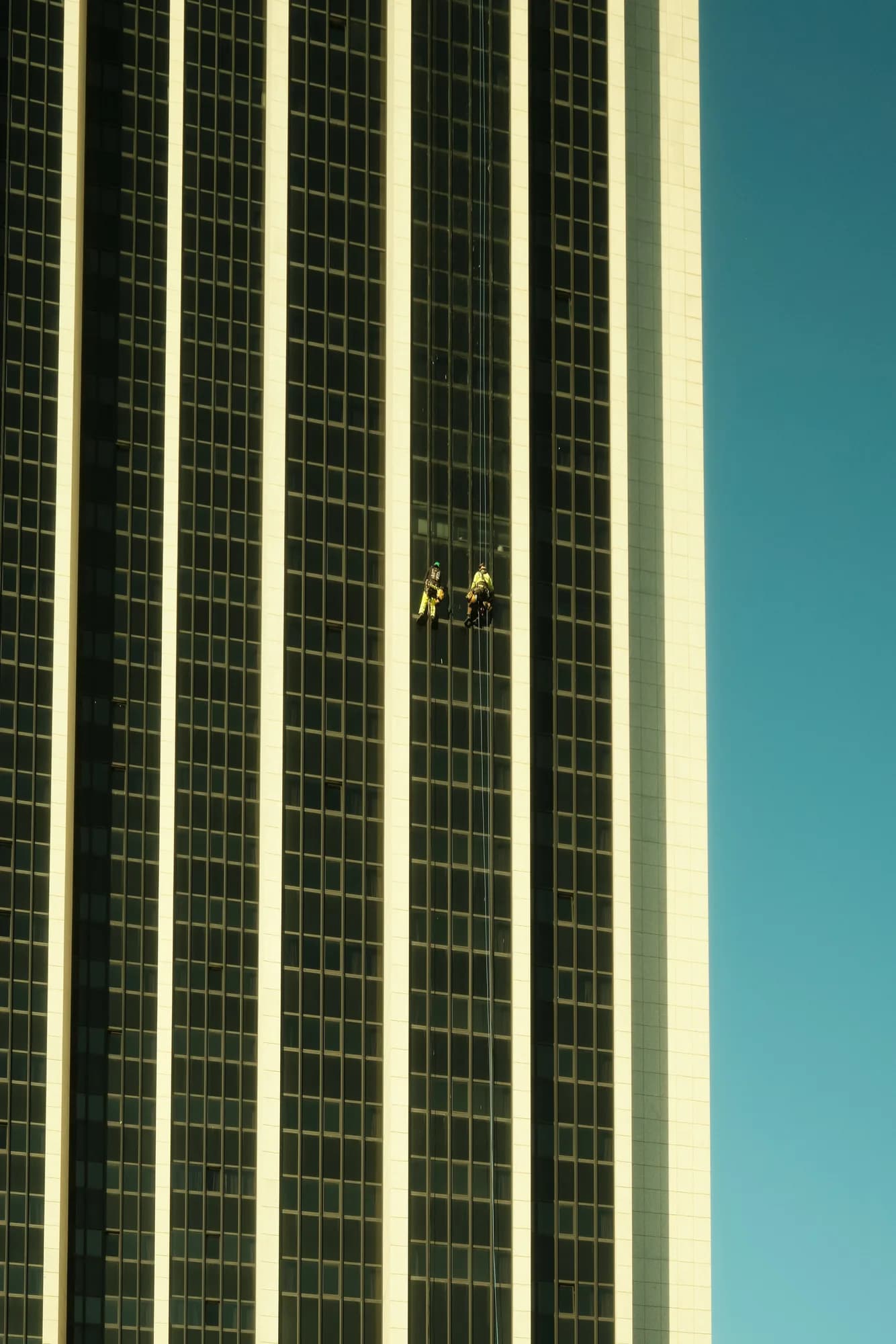
A property manager does not deal with height work as one line item but as ten small jobs scattered across the year. Green growth on the north wall, a blocked downpipe, a lump of render fallen above the entrance, pigeons on a ledge, dirty glass in the stairwell, a sheet of metal loosened on the parapet after a windy night. Each one brings its own survey, its own quote, its own handover and its own invoice.
Yet they share one common denominator: access. Once the anchors are set on the roof and someone is on the rope, it makes little organisational difference whether the task is washing glass, clearing a gutter, fitting netting or patching render. That is why we offer managers a working relationship covering the whole building exterior rather than a single service, and why it pays to plan maintenance a season ahead instead of reacting to one emergency at a time.
What's included
- One contractor for all height work and the whole building exterior
- A quote in a form you can put before a meeting or a written vote
- Rope access, so no scaffolding and no yard taken over for weeks
- Before-and-after photo records and a handover protocol as evidence for owners
- Public liability insurance, with a copy of the policy provided on request
- A maintenance plan a season ahead and availability for emergency call-outs
One contractor instead of five
One firm washes the facade, a second clears the gutters, a third handles the pigeons, a fourth the parapet flashing and a fifth the stairwell windows. Each needs a survey, each sends a quote structured differently, each wants a different date and each charges separately for turning up. What eats the manager's time is not the work itself but the coordination.
When a single crew does it, most of that overhead disappears. Several tasks can be hung on one roof set-up, and instead of five handovers there is one. Nobody points the finger at another contractor when a problem turns up at the boundary either, for example a leaking parapet that the gutter cleaner and the sheet-metal worker keep passing back and forth.
- One visit can combine gutter clearing, a parapet check and glass washing.
- We fit bird barriers straight after facade cleaning, while the surface is clean.
- Small repairs found during a survey can be done on the spot, without a second set-up.
What we do for a property manager, and what we do not
We are specialists in the building exterior and in everything that requires access at height. That is our entire scope, and to be blunt, outside it we would be worse than the firms that do such work every day.
We do not do internal cleaning of apartment blocks, meaning the regular cleaning of corridors, stairwells and common areas. Nor do we carry out lift, electrical or gas inspections, landscaping or pest control. A manager usually has their own suppliers for these, and we have nothing better to offer in their place.
- Cleaning and washing facades, including removal of algae and moss.
- Washing windows, glazing and light wells at height.
- Cleaning roofs, gutters, downpipes and roof drains.
- Fitting bird netting and spikes, including removal of droppings.
- Local facade and render repairs and painting at height.
- Installations at height: aerials, cameras, signage, house numbers.
- Emergency make-safe of loosened elements and post-storm inspections.
A typical panel-block problem and the service that solves it
Most of what a manager sees on a building has one specific cause and one specific remedy. The table below links what is visible from the pavement with what lies behind it and which service addresses it. It also works as a handout when a meeting needs to hear why something should not wait another year.
| What you see on the building | What is behind it | Which service solves it |
|---|---|---|
| Green and black patches on the north side of the facade | Algae and moss hold moisture in the render, which freezes and expands in winter and starts to crumble the surface | Facade cleaning |
| A wet band on the render under the gutter, water running down the wall | A blocked gutter or downpipe, usually leaves, moss and pigeon droppings | Gutter cleaning |
| Debris and moss on the roof, standing water near the drains after rain | Trapped moisture loads the waterproofing and tears it in frost | Roof cleaning |
| Droppings and feathers on ledges, nests in unused loggias | Pigeon droppings are acidic, damage surfaces and pose a hygiene risk | Bird netting and spikes |
| A lump of render fallen above the entrance, cracks near the parapet | Water ingress and debonded render that can fall onto the pavement | Facade repairs |
| Dirty glass in stairwells and the glazed entrance lobby | Surfaces that cannot be reached from inside or from a ladder | Window cleaning at height |
| Rattling flashing, a torn-off downpipe, something hanging after a gale | Corroded or loosened fixings that the wind finished off | Emergency height work |
| A need to fit a camera, aerial, flagpole or house number at height | The spot is out of reach of a platform, or a platform cannot get to it | Installations at height |
| Soiled paving at the entrance, on a terrace or in parking bays | Moss-filled joints are slippery in winter and the paving starts to settle | Paving cleaning |
Facility management: where we are strong and where we are not
Facility management today covers a very wide field, from cleaning and building maintenance through plant inspections, energy and waste management to tenancy administration. We do not provide full facility management and we do not pretend to. We are a specialist supplier of one part of it: the building exterior and everything that requires access at height.
For a facility manager that has a practical consequence. They do not need us in place of their service provider, but as a subcontractor for the part of the portfolio a general maintenance crew cannot handle, because working at height needs training, equipment and insurance they do not have. That is exactly how we work across several buildings.
If you are looking for a contractor to manage a whole property including plant and cleaning, we are not it. If you are looking for a crew that reliably covers the roof, the facade and everything above the first floor, that we can talk about.
A quote in a form you can put before the owners
We prepare the quote so it can be attached to a meeting invitation or a written vote without anyone having to retype it. An owner who is not a technician must be able to grasp from a single page what will be done, why, what it costs and what happens if it is not done.
That is why the quote comes with photographs of specific spots on your building, not stock images. A photo of debonded render above their own entrance convinces a meeting far more reliably than any sentence in a quote.
- The scope described in plain language, not in trade shorthand.
- The extent in units of measure, that is square metres or running metres.
- Price excluding and including VAT, plus unit rates so quotes can be compared.
- What the price excludes, for example replacing damaged parts found during the work.
- The expected date, duration of the works and validity of the quote.
- Photographs of the problem areas on your own building.
If you need to compare several quotes, tell us. We will itemise ours so it can be set beside a competitor's and show where the scope differs, not just the number at the bottom.
What comes out of the repair fund and how to justify it
Work on the common parts of a building, meaning the facade, roof, parapet, gutters, shared windows and railings, is normally paid from the repair fund, more precisely the operation, maintenance and repair fund the building maintains under Act No. 182/1993 Coll. on the ownership of flats and non-residential premises. Conversely, work on something used by a single owner, such as bird netting on their balcony, is usually paid by that owner.
Justifying it to owners is easier when the manager has three things to hand at once: photos of the damage, an explanation of what happens after another winter, and a comparison with the cost of doing it from scaffolding. Owners rarely object to the expense as such, they object to nobody explaining what it is for.
The repair fund is not bottomless, which is precisely why small items are worth dealing with early. Clearing a downpipe costs a fraction of repairing a soaked corner of a top-floor flat two years later, and an expense explained that way passes a meeting far more easily than general talk about prevention.
What exactly comes out of the repair fund and how the spend is voted on is governed by law and by your building's management contract. This is not legal advice, so verify the specific procedure with your manager or the building's solicitor.
Rope access versus scaffolding: what it means for the building
Scaffolding around a panel block is an investment in itself. You pay for delivery, erection, hire for every week started, dismantling and, where it encroaches on the pavement, a public space occupation fee. For a few metres of repair or a facade wash it never pays for itself.
Add to that the costs nobody invoices and the building bears anyway. Scaffolding is a convenient ladder to windows on every floor, so the burglary risk rises and the building has to deal with securing flats and sometimes with hiring a guard. Parking spaces in the yard are gone for a month and owners have a structure in front of their windows they cannot see past. That is why nobody wants scaffolding in the yard for longer than strictly necessary.
Rope access sidesteps all of this, because the workplace moves with the operative. Scaffolding regains its purpose only for a full building refurbishment, that is insulating the entire envelope. There scaffolding has to go up and rope access will not replace it.
Working without closing the pavement or blocking parking
The area below a workplace at height must be secured, there is no way around it and nobody serious will promise otherwise. The difference is how much space and for how long. With rope access it is a fenced zone that moves along with us, meaning a few parking spaces for a few hours rather than the whole yard for a month.
If there is a pavement, a garage entrance or a bin store below the facade, we agree the sequence with you in advance rather than on the spot with residents. We can start from the side with the fewest cars in the morning, or split the work so the access route stays clear throughout.
Coordinating with residents and notices in the entrances
What generates most calls to a manager is not noise but surprise. When a resident on the seventh floor suddenly sees someone on a rope outside the window, they pick up the phone. So before we start we draft the text of a notice for the entrances and send it to you for approval, so you can post it and circulate it through your own channel.
- What will be done and which side of the building we start on.
- On which days and at what times, so people know when their privacy is limited.
- A request to close windows and take dryers and flowerpots off sills and balconies.
- A note on where the fenced zone will be and where not to park on those days.
- A phone number for our person on site, not only for the manager.
Before-and-after photo records as evidence for owners
Height work has an awkward property: it happens where nobody can see. From the pavement an owner cannot tell whether a gutter was cleared along its whole length or only the first five metres, and the manager cannot judge it from the office either. So we photograph the condition before we start, the work in progress at points that will later be inaccessible, and the finished state.
For the manager it also protects both sides. If a damaged sill or cracked pane turns up a month later, the photos show whether the damage was there before we arrived. The same photos are the best material for the next meeting, because they show what the building got for its money.
Handover and the paperwork you receive
We hand the work over on site, not by email. We walk the scope with you, point out places that will deserve attention next season, and flag anything we found during the works that was not in the original quote, for example a corroded railing fixing or a cracked downpipe behind a facade element.
- A handover protocol with the date, scope and both parties' signatures.
- Photographic records of the condition before and after the works.
- A statement of works actually carried out if the scope changed during the job.
- An invoice with the agreed payment terms, on request summarised per period.
- A copy of the insurance policy and operative records if you keep them on file.
Public liability insurance
We hold public liability insurance for damage caused in the course of our work. At height that is not a formality. A dropped tool, a scratched car below the building, a pane cracked during handling or a damaged sill are risks no amount of care can eliminate, only reduce and insure.
We provide a copy of the policy on request and many managers file it with the order. Ask for it from every height-work contractor, not only from us. An uninsured contractor is cheap for a building only until something goes wrong.
What to check on a height-work contractor
Height work is one of the few fields where the difference between a good and a bad contractor shows not in the result but in what did not happen. The following can be checked before you sign and cost you one email.
- Valid liability insurance and its limit relative to the value of the property.
- Valid working-at-height training for the operatives and their medical fitness.
- Who actually turns up: an in-house crew or an unknown subcontractor.
- How the area below the workplace will be secured and who arranges it.
- What happens to the waste, especially droppings, moss and roof debris.
- References on a comparable type of building, not just photos of nice facades.
The cheapest quote turns out dearest exactly when the contractor has no insurance and damage to the facade, a car or glazing ends up paid from the building's repair fund.
Periodic facade and roof inspection: what we look for
A rope inspection has one decisive advantage over one from the pavement: proximity. We see the facade over its full height from a few dozen centimetres and can tap the render, so debonded areas are heard before they are seen. Most of what turns up this way is cheaper to fix at that moment than when it becomes an emergency two years later.
- Hollow and debonded render, especially above entrances and under sills.
- Cracks at window reveal corners and at the parapet junction.
- The condition of parapet and sill flashings and the tightness of joints.
- Fixing and clearance of gutters, downpipes and roof drains.
- Corrosion of railing fixings on loggias and balconies.
- Loose fixings of signage, satellite dishes, dryers and air-conditioning units.
- The state of sealed joints between panels and any beginning of pigeon nesting.
A building maintenance plan a season ahead
Building maintenance is cheaper when it is done in the right season rather than when it can no longer be postponed. Some works have technical limits, for example render repairs need warmth and dry weather, and some have organisational ones, for example bird barriers go up outside the nesting season. We use the overview below when planning with managers.
| Period | What gets done | Why then |
|---|---|---|
| March to May | Post-winter inspection, clearing gutters and drains, checking the parapet and loose elements | After the frosts you can see what winter loosened, and downpipes must run clear before the summer downpours |
| June to August | Facade cleaning, window and glazing washing, render repairs, painting at height, installations | Materials need warmth and dry conditions to cure, and summer offers the most workable days on a facade |
| September to November | Gutter clearing after leaf fall, roof cleaning, fitting bird netting and spikes | Downpipes and drains must be clear before winter, and barriers are fitted outside the nesting season |
| December to February | Emergency call-outs, making loose elements safe, inspections, preparing quotes and votes | Wet and frost rule out most works, but there is time to get the owners' decision ready for spring |
A meeting or a written vote takes its time. If the building is to have its facade cleaned in summer, the quote must be on the table in winter or early spring at the latest, otherwise the job slips by a year.
Emergency availability: what we can do straight away
In an emergency the first step is making it safe, not repairing it. Loose parapet flashing, a hanging lump of render or a torn-off downpipe must first be brought to a state where it cannot fall on anyone, and the area below fenced off. The permanent fix comes afterwards, calmly and with a proper quote.
Call us, do not email. We will not promise a slot blind, as it depends on where we are working, but we will tell you straight when we can come so you know whether to look for someone else as well. After a gale it is sensible to order an inspection of the whole building at once, because more is usually loose than the one thing visible from the pavement.
Apartment block versus office building
The technique is the same in both cases; what differs is decision-making and operations. In an apartment block the owners decide through a manager or an association, the money comes from the repair fund, preparation takes weeks or months, and the work happens during the day while most people are out. The most sensitive point is privacy, because we work right outside people's windows.
In an office building the facility manager or the owner decides and the decision is usually far quicker. Operations, however, are more sensitive: someone on a rope outside a meeting-room window is a distraction, so glass and facade cleaning is often done early in the morning, after hours or at the weekend. Roof access, keys and cards, site induction and sometimes coordination with security also have to be sorted in advance.
Owners' association or management company
We work with both, and the difference is mainly who we talk to. In an owners' association it is usually the chair, who knows the building in detail but does the role alongside a day job, so materials need to arrive ready to use. In a management company it is a technician looking after several buildings at once who mainly needs a fast, comparable quote.
Where a manager runs several buildings it pays to agree recurring works across the portfolio rather than building by building. A visit can be planned so one mobilisation covers two or three properties in the same area, which shows up in both the price and the timing.
Where we fit into a building refurbishment
We do not carry out full building refurbishment, meaning insulating the whole envelope with scaffolding and the construction work that goes with it. We do what surrounds it, both before and after. Before a refurbishment it makes sense to clean the facade and roof so the true state of the substrate is visible and the designer is not guessing what lies under the moss.
After a refurbishment one thing comes back with some regularity: pigeons. New loggias, new flashings and new ledges create new nesting spots, and after a few seasons a fresh facade tends to be under droppings again. So it makes sense to deal with barriers straight away, while the surface is clean and the site set-up is still on the building.
- Cleaning the facade and roof before the substrate condition is assessed.
- Final cleaning of surfaces and glazing once construction work is finished.
- Local repairs to details left unfinished after the insulation works.
- Fitting bird netting and spikes to new loggias and ledges.
- Painting at height on surfaces that were not part of the refurbishment.
Panel blocks in Petržalka and Ružinov: the recurring issues
The buildings we work on most often in Bratislava have surprisingly similar weak points. The first is the north and north-east elevation, which dries slowest after rain and therefore grows algae and moss considerably earlier than the other walls. The second is the parapet and its flashing, the place where water most often gets into the structure.
The third tends to be the railing fixings on loggias, which corrode from within and only show themselves as a rust stain on the render, and the fourth the sealed joints between panels. During an inspection we look at these four first, because in most cases the problem is one of them.
What we have worked on in Bratislava
A list of references matters more when choosing a contractor than catalogue photographs, so we name specific buildings rather than quote numbers. Our experience comes from Slovakia and from Switzerland, where work at height runs under a stricter regime, and we brought that habit with us.
- Eurovea, cleaning glazed canopies at height.
- Hotel Carlton, local facade repair on a historic building.
- Vajnorská street, painting at height for Tulipa s. r. o.
- Restoration of a fire-damaged facade, including removing residues and preparing the substrate.
What drives the price on an apartment block job
The price is set by the extent in units of measure, the height of the building, the access method and the condition of the surface, that is how much work it demands. Two facades of the same size can differ markedly in price depending on whether it is ordinary soiling or years of moss growth that has to be removed gradually and gently.
- Area in square metres or length in running metres.
- Number of floors and whether the work can be done from rope, a platform, or needs scaffolding.
- The state of the surface and the number of passes it therefore needs.
- Whether the area below can be secured and how the roof is reached.
- Timing, since work outside the peak season is usually easier to book.
- Whether it is a one-off job or recurring work across several buildings.
For an ongoing arrangement we can agree unit rates for a set period, so you do not have to request a quote for every small item and can budget maintenance in advance.
What we need from you to prepare a quote
For a first estimate an address and a few photos are usually enough; we survey on site for larger jobs or where access is complicated. The more precise the information we get, the less the price will move during the works, and it is precisely price changes that cause a manager trouble with the owners.
- The address of the building and the number of storeys above ground.
- Photos of the problem areas both from a distance and close up.
- Whether the facade is insulated and when it was last refurbished.
- Whether roof access is available and how it is reached.
- Timing constraints, for example a scheduled meeting or other construction work.
- A contact for the person who can open up access on site.
Where in Bratislava we work
We work across Bratislava including Petržalka, Ružinov, Nové Mesto, Staré Mesto, Karlova Ves, Dúbravka, Rača, Vrakuňa and Podunajské Biskupice, and by arrangement also in Senec, Pezinok, Malacky and Stupava. Apartment blocks in Petržalka and Ružinov make up the largest share of our work for managers, while in the Old Town it is more often office and historic buildings.
How it works
Survey and schedule of works
We go over the building from rope or from the ground and set out what needs doing now, what will last another season and what would be money wasted.
A quote prepared for the owners
We put together an itemised quote with photos, ready for a meeting or a written vote, and fix the date once the outcome is known.
Delivery, photo records and handover
You put up the notice, we work without scaffolding behind a fenced zone, and at the end hand over before-and-after photos, the protocol and the invoice.
💡 The price depends on the extent in units of measure, the height of the building, the access method and the condition of the surface. Send the address, the number of floors and photos and we usually deliver an owner-ready quote within 24 hours.
Frequently asked questions
How much does cleaning an apartment block's facade or roof cost?
The price is set by the area, the height of the building, the access method and the condition of the surface, so it cannot be given without photos. Send us the address, the number of floors and a few photos and we will prepare an itemised quote you can put before the owners.
Can it be paid from the repair fund?
Work on the common parts of a building, meaning the facade, roof, parapet, gutters or shared windows, is normally paid from the operation, maintenance and repair fund. Anything concerning a single flat or balcony is usually paid by that owner. Check the exact procedure and voting method in your management contract.
How quickly can you prepare a quote for an owners' meeting?
For a routine job usually within 24 hours of receiving photos, for a larger property within a few working days of the survey. If you have a fixed meeting date, tell us in advance and we will work to it.
Do we have to erect scaffolding for this?
Not for cleaning, washing, installations or local repairs; we do those from rope or a platform. Scaffolding only makes sense for a full refurbishment, that is insulating the entire envelope, where it cannot be avoided.
Will you need to close the pavement or car park?
The area below the workplace must be fenced, but it is a zone that moves along with us. In practice that means a few parking spaces for a few hours, not closing the whole yard. We agree the sequence with you in advance and put it in the residents' notice.
What if you damage something during the works?
We hold public liability insurance for damage caused in the course of our work and provide a copy of the policy on request. We also photograph the condition beforehand, so it is always possible to show what was on the building before we arrived and what was not.
Do you also clean apartment blocks internally?
We do not do the regular cleaning of corridors, stairwells and common areas; managers have their own cleaning service for that. We specialise in the exterior and in work at height: facades, roofs, windows, gutters, bird barriers, installations and repairs.
How often should a building have its facade and roof inspected?
A sensible interval is once a year, ideally in spring after the winter, plus an extra check after a strong gale. Winter is what loosens render and flashings most, and damage repaired in spring costs less than an emergency in summer.
Can we arrange ongoing work across several buildings?
Yes, and across several properties it also makes financial sense. We agree unit rates for a period and a seasonal plan of works, so you need not request a quote for every small item and one visit can cover two or three buildings in the same area.
Related services
Need cleaning or work at height?
Get in touch and we'll prepare a tailored, no-obligation quote, usually within 24 hours.